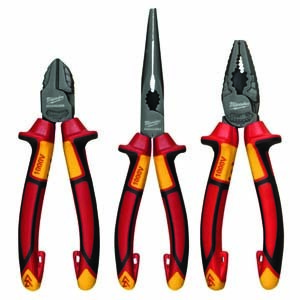
Milwaukee VDE Cutting Tools
When trimming cable at a board, Milwaukee VDE cutting tools give sparkies insulated cutting edges matched to the job.
Choose cable cutters for copper and aluminium conductors, or side cutters for wire within their stated capacity. Insulation does not replace safe isolation. Shop the range by cutting capacity, not just handle size.
What Are Milwaukee VDE Cutting Tools Used For?
- Cut copper and aluminium conductors to length during consumer unit changes, using cable cutters rated for the conductor size and construction.
- Trim wire during accessory installation with side cutters matched to the material hardness, rather than forcing cable-cutting jaws through unsuitable wire.
- Prepare cable ends for termination with a suitable insulated cable knife, controlling blade depth to avoid scoring the conductor insulation underneath.
- Grip, bend and cut suitable wire during first-fix and second-fix electrical work with combination pliers where their stated cutting capacity covers the job.
Choosing the Right Milwaukee VDE Cutting Tools
Choose the cutting edge for the material first; the insulated handles do not make every cutter suitable for every wire.
1. Cable Cutters or Side Cutters
For regular conductor preparation, choose Milwaukee VDE Cable Cutters within the stated cable capacity. For wire trimming, choose Milwaukee VDE Side Cutters & Diagonal Cutters and check the separate ratings for soft, hard and piano wire where specified.
2. Dedicated Cutting or Combined Tasks
If you spend the day cutting conductors, buy a dedicated cutter. If you also need to hold and bend wire, compare Milwaukee VDE Pliers & Cutters. Combination pliers cover several tasks, but their cutting capacity still needs checking.
3. Capacity and Access
For thicker conductors, select enough cutting capacity and leverage to finish the cut without excessive force. For restricted enclosures, check head dimensions as well as overall length. Cable diameter and conductor cross-sectional area are different measurements; use the rating given for the actual cable construction.
4. Insulation Markings
Look for the voltage rating, double-triangle symbol and applicable insulated-tool standard on the specific tool. Ordinary dipped grips are not a substitute for certified insulation, and a VDE rating is not permission to work live.
Who Uses Milwaukee VDE Cutting Tools?
Installation electricians use Milwaukee VDE cutters when dressing conductors into boards and preparing cable for sockets, switches and isolators. Maintenance sparkies use them for replacement wiring and equipment repairs after safe isolation. Apprentices building a kit should start with cutters suited to their regular cable sizes, rather than expecting one pair to handle cable, steel wire and stripping work.
The Basics: Understanding VDE Cutting Tools
The important distinction is between an insulated tool and an ordinary cutter with comfortable grips. The cutting jaws remain exposed metal; protection depends on the certified insulation being intact and the tool being used correctly.
1. What the Voltage Rating Covers
Tools marked to IEC 60900 for 1,000V AC use are designed for specified electrical working conditions. The rating concerns insulation, not cutting strength, and does not mean the jaws are electrically isolated from anything they touch.
2. Why Testing Does Not Replace Inspection
Factory electrical testing checks the insulation before the tool enters service. Cuts, burns, contamination and storage damage can compromise it afterwards. Inspect before use, follow safe-isolation procedures and remove damaged tools from service.
Supporting Kit for Electrical Cutting and Termination
Protect the insulation in storage and carry the separate tools needed to prepare and terminate cable properly.
1. Protective Tool Storage
A pouch or case with separate compartments keeps insulated handles away from loose blades and drill bits. Do not leave cutters rattling around in a box where sharp kit can gouge the insulation.
2. Insulated Screwdrivers
Use the correct driver for terminals rather than twisting them with cutter jaws. Choose suitable tips from Milwaukee VDE Screwdriver Sets & Screwdrivers; connections with specified tightening torques need an appropriate torque tool.
3. Suitable Voltage Testing Equipment
Insulated cutters cannot tell you whether a circuit is dead. When considering Milwaukee Electrical Testing, select equipment appropriate to the task. Proving dead requires a suitable two-pole voltage indicator and a means of proving it before and after testing, not a non-contact detector alone.
Choose the Right Milwaukee VDE Cutting Tools for the Job
Match the cutter to the material, cable construction and available working space.
| Your Job | Cutter Type | Key Features |
|---|---|---|
| Cutting copper or aluminium conductors to length | VDE cable cutters | Suitable conductor capacity and cable-cutting jaw profile; check stranded and solid cable limits. |
| Trimming wire during installation | VDE side cutters | Published capacity for the wire material and hardness, with a head that fits the working space. |
| Gripping, bending and cutting suitable wire | VDE combination pliers | Gripping jaws and cutting edges with sufficient capacity for the task. |
| Opening a cable sheath before termination | VDE cable knife | Blade profile suited to the sheath, a secure grip and controlled cutting depth. |
Common Buying and Usage Mistakes
- Using copper cable cutters on steel wire or armour can notch the cutting edges. Use a tool explicitly rated for that material.
- Buying by overall length alone can leave you short of cutting capacity. Check conductor size, construction and material against the model specification.
- Treating insulated handles as permission to cut an energised cable creates a serious shock and arc risk. Isolate, secure against reconnection and prove dead before cutting.
- Stripping conductors with ordinary cutting jaws can nick strands and weaken the termination. Use a suitable stripping tool unless the cutter has a specified stripping function.
- Taping over damaged insulation does not restore certification. Remove the tool from electrical service and replace it or seek the manufacturer's assessment.
VDE Cable Cutters vs Side Cutters vs Combination Pliers
VDE Cable Cutters
Choose these for repeated cuts through copper and aluminium cable within capacity. Their jaw profile suits conductors, but it is not a reason to use them on steel wire, armour or hardened fixings.
VDE Side Cutters
Choose these for wire trimming where the material falls within the model's stated ratings. They can be more useful around individual wires than larger cable-cutting heads, but do not assume every pair handles hardened wire.
VDE Combination Pliers
Choose these when holding and bending wire matter alongside occasional cutting. They reduce tool changes, but dedicated cutters are the better choice when cutting capacity, access or repeated cuts drive the job.
Maintenance and Care
Inspect Before Each Use
Check the full insulated surface for cuts, cracks, burns and loose sections. Check the jaws and pivot too. Remove tools with damaged insulation, distorted jaws or doubtful condition from service.
Clean Without Damaging Insulation
Wipe away cable debris and dirt using the manufacturer's recommended cleaning method. Avoid aggressive solvents and abrasive cleaning, and dry the tool before storage.
Keep the Pivot Working Freely
Where permitted by the instructions, apply a small amount of suitable lubricant to the joint and wipe away excess. Do not leave oily handles that compromise grip or attract contamination.
Protect Edges and Handles
Store cutters dry, away from heat and sharp loose tools. Do not grind damaged cutting edges or patch insulation yourself; seek manufacturer advice or replace the tool.
Your Milwaukee VDE Cutting Tools Range, Ready to Go
ITS stocks the full Milwaukee VDE cutting tools range, covering cable cutters, side cutters, pliers and cable knives for electrical installation and maintenance. Stock is held in our own warehouse, ready for next-day delivery on eligible orders. Check the individual listing for current availability and delivery details before booking the job.
Milwaukee VDE Cutting Tools FAQs
What does VDE mean on Milwaukee tools?
VDE is an independent electrical testing and certification organisation. On Milwaukee insulated tools, the VDE mark identifies certification to the applicable requirements for that tool. Check the tool's voltage marking and IEC 60900 marking rather than relying on the red and yellow handle colours alone.
Are Milwaukee VDE cutters 1000V rated?
Milwaukee VDE cutters are rated for use up to 1,000V AC as marked on the tool. Check the specific model and its instructions before use. The rating applies to the insulation under specified conditions; it does not make cutting an energised conductor safe.
What VDE cutting tools does Milwaukee make?
Milwaukee's VDE range includes diagonal or side cutters, cable cutters, combination pliers with cutting edges, and cable knives. Choose by task: conductor cutting, wire trimming, combined gripping and cutting, or sheath removal. Sizes and cutting capacities vary between models.
Are Milwaukee VDE tools individually tested?
Yes. Milwaukee specifies individual testing at 10,000V for its VDE insulated tools, supporting their rated use up to 1,000V AC. That factory test voltage is not a working voltage. It also does not remove the need to inspect the insulation before every use.
Can Milwaukee VDE cutters cut hardened wire?
Only where the specific model lists a suitable hard-wire or piano-wire cutting capacity. A copper and aluminium cable rating does not cover hardened steel. Check both the material and maximum diameter; using the wrong cutter can chip or notch the edges.
Do Milwaukee VDE tools have a lifetime warranty?
Milwaukee offers a limited lifetime guarantee on eligible hand tools, subject to its terms. Confirm coverage for the particular VDE cutter before buying. This is not a lifetime guarantee of insulation condition, and normal wear, misuse or accidental damage should not be assumed covered.
How should VDE tools be inspected?
Before each use, examine the insulation for cuts, cracking, burns, looseness and contamination. Check that the jaws, pivot and any hand guards are sound, and that identification markings remain legible. If damage or condition raises doubt, remove the tool from service; tape is not an acceptable insulation repair.
Are Milwaukee VDE tools suitable for live working?
Correctly rated, undamaged VDE tools can form part of the equipment used by competent persons where live work is legally justified and properly controlled. They do not make routine live cutting acceptable. UK electrical work should be carried out dead wherever possible, using safe isolation, securing against reconnection and proving dead.