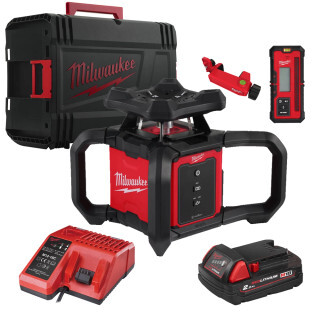
Milwaukee M18 Laser Levels
Milwaukee M18 line laser kits give you fast, accurate set-out for stud, fix, tile and first fix work without dragging leads or hunting sockets on site.
If you're marking kitchens, lining up tray, setting ceiling track or keeping long runs true, a Milwaukee m18 line laser saves time straight away. The green beam is easier to pick up indoors, the M18 platform keeps it on the same batteries as the rest of your kit, and body only or kit options let you buy to suit what is already in the van. For the wider range, see Milwaukee M18 Lasers, Detectors & Digital Measures and get the right laser for the job.
What Are Milwaukee M18 Line Lasers Used For?
- Setting out stud walls and partition runs is quicker with an m18 line laser because you can throw clear horizontal and vertical lines across the room instead of constantly moving a pencil line and level.
- Fitting kitchens, wall units, splashbacks and shelving is easier when a milwaukee m18 cross line laser keeps every fixing line running true across uneven walls and awkward corners.
- Running first fix for electrical and plumbing work is cleaner when you need straight lines for tray, conduit, pipe clips, back boxes or bracket positions along long walls and corridors.
- Tiling bathrooms, plant rooms and utility spaces goes smoother when a milwaukee m18 green laser gives you a visible reference for rows, centres and verticals without someone holding a straightedge.
- Suspended ceiling and interior fit-out work benefits from a milwaukee 18v line laser when you are carrying out repeat set-out through multiple rooms and do not want leads underfoot.
Choosing the Right Milwaukee M18 Line Laser
Sorting the right one is simple. Match the beam layout and kit format to the work you actually do, not the badge on the side.
1. Cross Line or More Coverage
If you are mainly doing kitchens, sockets, stud and general internal fit-out, a Milwaukee m18 cross line laser is usually the sensible choice. If you are setting out more complex rooms, longer runs or multiple planes at once, step up to a model with extra lines so you are not forever repositioning it.
2. Green Beam for Indoor Visibility
If you work in bright interiors, shop fits or big open spaces, a Milwaukee m18 green laser is easier to see and faster to work from. If visibility is poor with the naked eye at distance, that is your cue to look at detector compatible options rather than forcing the wrong laser to do too much.
3. Body Only or Kit
If you already run M18 gear, a Milwaukee m18 line laser body only makes sense and saves buying batteries you do not need. If this is your first M18 measuring kit or it is staying with one installer or van, the kit version is the easier buy because you are ready to work straight away.
4. Think About Mounting Before You Order
Do not just buy the laser and hope the room suits it. If you are working over kitchen carcasses, in stairwells or across open floor areas, proper mounting matters. Have a look at Milwaukee Laser Tripod & Accessories so the laser can actually sit where the job needs it.
Who Uses These on Site?
- Sparkies use a milwaukee m18 line laser for setting socket lines, tray runs and containment so a full room stays level without checking every mark by hand.
- Kitchen fitters and chippies swear by them for cabinet lines, worktop support positions and first fix set-out where one bad reference throws the whole room out.
- Dryliners and ceiling fixers rely on an m18 line laser for track, channel and ceiling grid layout, especially on bigger commercial jobs where speed matters.
- Plumbers and HVAC fitters use them for bracket runs, pipe clips and service alignment in plant rooms, risers and long corridor work where a straight run needs to stay straight.
- Site managers and snag teams keep one handy for quick checks when walls, rails, frames or fitted units look suspect and a tape alone will not settle the argument.
The Basics: Understanding Milwaukee M18 Line Lasers
These save time by projecting level and plumb reference lines straight onto the work area. The main thing is knowing what type of laser suits room-by-room fitting and what needs a bigger site setup.
1. Line Lasers for Internal Set-Out
A line laser throws a straight horizontal line, a vertical line, or both, across the wall, floor or ceiling. That is what you want for cabinets, sockets, stud, tiling and general first fix where the job is happening inside rooms rather than across a whole site.
2. Self Levelling Does the Correcting for You
Self levelling means the laser corrects itself when the surface is slightly out, so you are not wasting time packing it with scraps to get the beam right. On a real job, that means quicker setup and fewer bad marks when moving room to room.
3. When a Rotary Laser Makes More Sense
If you are levelling over long distances, outside, or across full floors and site areas, a line laser is not always the right answer. That is where Milwaukee M18 Rotary Lasers come in, giving wider coverage for bigger setting out work.
Laser Accessories That Make Site Setup Easier
A good laser is only half the job. The right extras stop bad setup, flat batteries and wasted time between rooms.
1. Tripods and Mounts
A proper tripod or mount stops you balancing the laser on offcuts, buckets or a window board that is not even true. It gives you repeatable height and position, which matters when fitting kitchens, ceiling track or long fixing lines.
2. Spare Batteries
Do not get caught halfway through a set-out when the laser dies and the only charged pack is in another van. Keeping spare Milwaukee M18 Batteries on hand keeps the job moving.
3. Laser Detectors
When the room is too bright or the distance is pushing it, a compatible detector makes the beam usable rather than guesswork. It is a smart add-on for larger interiors and more demanding set-out work.
Choose the Right Milwaukee M18 Line Laser for the Job
Use this as a quick guide before you buy.
| Your Job | Category or Type | Key Features |
|---|---|---|
| Setting sockets, tray and stud in single rooms | M18 cross line laser | Horizontal and vertical lines, quick self levelling, cordless setup |
| Kitchen fitting and cabinet runs | M18 green line laser | Brighter indoor beam, cleaner wall references, easier visibility over longer runs |
| Multi room fit-out and repeated first fix | M18 line laser kit | Battery and charger included, ready for one van or dedicated installer |
| Existing M18 users adding measuring kit | M18 line laser body only | No extra batteries to pay for, suits teams already on the M18 platform |
| Long distance or bigger site levelling | Rotary laser instead of line laser | Better outdoor and wide area coverage, detector use, whole site level work |
Common Buying and Usage Mistakes
- Buying a line laser for full site levelling is the usual first mistake. It is ideal for room set-out and interior alignment, but for long distance external work you are better off with a rotary laser.
- Choosing body only without checking your battery setup catches people out. If you do not already run M18 packs and chargers, the cheaper buy soon turns into a delay on day one.
- Trying to work without a proper mount or tripod leads to bad references and repeated setup. If the laser is perched on whatever is nearby, expect wonky lines and wasted time.
- Assuming brighter rooms will be fine without checking beam visibility can slow the whole job down. Green beam models are usually the smarter call for indoor visibility and larger spaces.
- Using a laser as your only check on rough surfaces is asking for trouble. Keep a set of Spirit Levels handy for quick verification when floors, frames or temporary supports are suspect.
Green Line Laser vs Red Line Laser vs Rotary Laser
Green Line Laser
Best for indoor trade work where visibility matters. A Milwaukee m18 green laser is easier to see in bright rooms and over longer internal runs, which makes it the better choice for kitchens, fit-outs and first fix.
Red Line Laser
Fine for lighter duty or shorter range indoor setup, but harder to see in brighter conditions. If you are constantly working under strong site lighting or near windows, red can become more hassle than saving.
Rotary Laser
This is the pick for bigger areas, external work and long distance level checking. It is not the first thing most fitters need for room set-out, but it is the right tool when a line laser runs out of reach.
Body Only vs Kit
Body only suits existing Milwaukee users who already have charged M18 packs ready to go. A kit is the safer buy if this is your first cordless line laser Milwaukee M18 setup or you want one complete package for the van.
Maintenance and Care
Keep the Lenses Clean
Dust on the lens dulls the beam and makes the line harder to read. Wipe it down with a soft cloth after use, especially after dusty first fix or chasing work.
Store It Properly
Chuck it loose in the van and it will get knocked about. Keep the laser in its case between jobs so the pendulum and housing are protected during transport.
Check Accuracy After a Knock
If it has taken a proper drop, do not just carry on and hope for the best. Run a quick accuracy check before setting out a room, because one bad laser line can ruin a day of fitting.
Look After Batteries
Do not leave packs flat for ages in the van. Keep batteries charged and rotated so your laser is ready when the job starts, not halfway through after a hunt for power.
Replace Worn Mounting Parts
Loose threads, worn brackets or damaged mounts make precise setup a pain. Replace those bits early rather than fighting movement every time you set the laser up.
Why Shop for Milwaukee M18 Line Lasers at ITS?
Whether you need a Milwaukee m18 line laser body only, a full kit, or a milwaukee 18v line laser for fit-out and first fix, we stock the proper range. That means cross line models, green beam options, accessories and matching M18 gear, all held in our own warehouse and ready for next day delivery.
Milwaukee M18 Line Laser FAQs
What's the difference between a line laser and a rotary laser?
A line laser is the one most fitters, sparks and chippies want for room-by-room set-out. It throws visible lines across walls, floors and ceilings for stud, cabinets, sockets and tiling. A rotary laser is more for bigger areas, longer distances and site levelling work, especially outside.
Are the Milwaukee M18 line lasers green or red?
The Milwaukee M18 line laser range commonly focuses on green beam models, which are easier to see indoors and in brighter working conditions. Always check the individual product spec, but if visibility is a big part of the job, green is usually the one trades reach for.
Does the Milwaukee M18 laser self-level?
Yes, Milwaukee M18 line lasers are built to self-level, which is exactly what you want on site. It saves messing about trying to shim the tool level by hand and helps you get accurate reference lines faster when moving from room to room.
Is the Milwaukee M18 line laser sold body only or as a kit?
It is available both ways depending on the model. If you already run M18 tools, body only is the obvious money saver. If not, a kit is the cleaner buy because you are not stuck sourcing batteries and a charger before the first job.
Does the Milwaukee line laser come with a battery and charger?
Only kit versions come with the full setup. Body only models do not include battery or charger, so check the listing properly before ordering. If in doubt, buy the kit or make sure you have spare M18 packs on the shelf.
Is a Milwaukee M18 line laser worth it if I already use hand levels?
Yes, if you are doing repeated set-out, long runs or multi-point fixing work. A hand level still has its place for quick checks, but a laser is much faster when you need the same line carried across a whole room without stopping every few minutes.
Will an M18 line laser do outside work?
For some external work, yes, but be realistic. Bright daylight can wash out the beam, so line lasers are mainly strongest indoors or in controlled conditions. For bigger outside levelling jobs, a rotary laser and detector are usually the better answer.