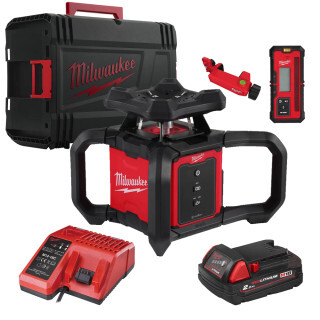
Milwaukee M18 Lasers, Detectors & Digital Measures
Milwaukee M18 laser level kit is for set out that has to stay dead right, whether you're framing, fixing track, levelling kitchens or working across big rooms.
If you're laying out walls, ceilings or first-fix runs, a Milwaukee M18 Laser Levels range makes sense. These cordless lasers run on the same Milwaukee M18 platform many trades already carry, so you're not dragging around odd chargers and spare systems. Expect clear lines, proper site-tough housings and runtime that suits full-day set out. If you're buying a milwaukee m18 laser level, match the beam type and working range to the jobs you actually do.
What Are Milwaukee M18 Laser Levels Used For?
- Setting out stud walls, service risers and partition lines on first fix jobs where a straight reference saves you pulling work back later.
- Levelling kitchen units, wall cabinets and long worktop runs where a visible line across the room is quicker than shifting a spirit level every metre.
- Installing ceiling track, pipe brackets and cable containment in refurbs and shell fit-outs where you need repeatable height marks all day.
- Working across larger internal spaces and external set out with a receiver, especially when a Milwaukee M18 detector helps you pick up the beam in bright conditions.
- Checking datum lines for flooring, windows and second fix joinery where a cordless laser level Milwaukee M18 setup cuts down on remeasuring and snagging.
Choosing the Right Milwaukee M18 Laser Level
Sorting the right one is simple: buy for the size of the set out and where you work, not just the badge on the side.
1. Cross Line or Rotary
If you're mostly indoors fitting kitchens, track, sockets or cabinets, a cross-line milwaukee m18 laser level is usually the sensible choice. If you're levelling over bigger distances, doing slabs, drainage or external set out, look at Milwaukee M18 Rotary Lasers instead.
2. Body Only or Kit
If you're already loaded up with charged M18 packs, a milwaukee m18 laser level body only saves money. If this is your first laser on the platform or it will live in a separate setting-out case, the milwaukee m18 laser level kit is the safer buy.
3. Indoor Work or Bright Site Conditions
For clear indoor rooms, the bare laser is often enough. If you're working near openings, in bright units or outside, plan on pairing it with a receiver because beam visibility always drops once the sun gets on it.
4. Runtime and Battery Size
A compact battery keeps weight down for general room-to-room work. If the laser is staying up all day on larger fit-out or groundwork jobs, step up to dependable Milwaukee M18 Batteries so you're not climbing down to swap packs halfway through set out.
Who Uses These on Site?
- Sparkies use a milwaukee 18v laser level for lining up tray, conduit, boxes and containment, especially on long corridor runs where being a few millimetres out soon shows.
- Dryliners and ceiling fixers swear by an m18 laser level for track, MF ceiling grid and partition set out because it keeps heights consistent right across the room.
- Kitchen fitters and chippies use them for cabinets, battens, door sets and finish lines, where one clean beam is quicker than constant pencil marks and straight edges.
- Plumbers and HVAC fitters reach for these when running bracket lines, clips and trunking, particularly in plant rooms and refits where alignment needs to stay tidy and repeatable.
- Site managers and snagging teams keep one handy for quick checks on handed-over work, because it shows up dips, drift and bad set out fast.
The Basics: Understanding Milwaukee M18 Laser Levels
These save time by throwing out a level reference you can trust, instead of measuring and remarking every point by hand. Here is the part that actually matters when you are choosing one.
1. Cross-Line Lasers
This is the standard choice for interior trade work. A cross-line unit projects horizontal and vertical lines for jobs like track, kitchen units, pipe clips, tiling and general room set out.
2. Rotary Lasers
Rotary models are built for longer distances and wider coverage. They are the better option for site levelling, drainage, slab prep and external work where one room line is not enough.
3. Detectors and Outdoor Use
In bright light, the beam can be hard to see with the naked eye even if the laser is still accurate. That is where a detector comes in, picking up the beam so you can keep working outside or across bigger open areas.
Milwaukee M18 Laser Accessories That Save Time on Site
The right extras stop bad setup, short runtime and wasted trips back to the van.
1. Laser Receivers and Detectors
If you are setting out in bright units or outdoors, a detector is what stops the whole job grinding to a halt because you cannot see the beam. It turns a laser that is fine indoors into something properly useful on bigger, brighter jobs.
2. Tripods and Mounts
A laser balanced on a stack of offcuts is asking for trouble. Proper Milwaukee Laser Tripod & Accessories make height changes easier, keep the beam steady and stop you knocking your set out out of line.
3. Spare M18 Batteries
A spare pack is a no-brainer if the laser is staying up all day. It is cheaper than lost time, especially when the beam is running through a full ceiling grid, long corridor or external level check.
Choose the Right Milwaukee M18 Laser Level for the Job
Pick the type that matches the space, light and distance you actually work across.
| Your Job | Laser Type | Key Features |
|---|---|---|
| Kitchen fitting, joinery and second fix inside finished rooms | M18 cross-line laser level | Fast horizontal and vertical lines, quick setup, easy room-to-room work |
| Partitioning, ceiling track and first fix layout | M18 multi-line laser level | More reference lines, better for walls, ceilings and repeated fixing points |
| External set out, slab levels and long-distance levelling | M18 rotary laser level | Longer working range, works with detector, better for open site conditions |
| Occasional use with batteries already on the van | M18 laser level body only | Lower buy-in cost, uses existing M18 packs and chargers |
| New platform user or dedicated setting-out kit | M18 laser level kit | Comes ready with battery and charger, easier to keep as a complete setup |
Common Buying and Usage Mistakes
- Buying a short-range indoor laser for outdoor set out is a common one. The beam may still be accurate, but if you cannot see or detect it in bright light, the tool is wrong for the job.
- Choosing body only without checking your battery situation catches people out. If your M18 packs are already tied up in grinders and drills, your laser ends up sitting dead in the case.
- Setting the laser on uneven scrap or loose materials wastes time and accuracy. Use a proper tripod or solid fixing point so you are not resetting every time someone brushes past.
- Ignoring working range on bigger jobs leads to slow set out and bad visibility. Check the distances you normally cover and step up to a rotary with receiver if that is the work you do.
- Treating the laser like a general site throwabout shortens its life. They are tough, but lenses, pendulums and mounts still need sensible handling and a proper case.
Cross-Line vs Multi-Line vs Rotary
Cross-Line
Best for everyday interior work like kitchens, sockets, battens and general room layout. It is usually the quickest and simplest option, but it is not the one for big outdoor distances.
Multi-Line
Better where you need more reference lines for partitions, ceilings and repeated fixing points. It gives you more layout help in one hit, though it can be more than you need for simple second fix jobs.
Rotary
This is the one for groundworkers, external set out and long-range levelling. It covers far more area and works properly with detectors, but it is overkill if you are just hanging cabinets in finished rooms.
Maintenance and Care
Keep the Lens Clean
Dust on the lens dulls the beam and makes line visibility worse than it should be. Wipe it down with a soft cloth after site use rather than leaving plaster and fine dust to build up.
Store It in the Case
Chucking a laser loose in the van is asking for calibration knocks and scratched glass. Keep it in its case so the body, mounts and controls are not battered by the rest of the kit.
Check Battery Contacts
Site dust and damp around the battery connection can cause poor contact or odd power issues. Give the contacts a quick check and keep your packs dry before clipping them in.
Recheck Accuracy After a Knock
Even tough lasers should be checked if they have taken a proper drop or been rattled around. A quick accuracy check is better than setting out half a floor wrong and finding out at second fix.
Replace Worn Mounts and Accessories
Loose mounts, bent brackets and tired tripod threads make setup awkward and unreliable. Replace the worn bits before they start affecting the line you are trusting for the whole job.
Why Shop for Milwaukee M18 Laser Levels at ITS?
Whether you need a compact m18 laser level for room set out or a larger cordless levelling solution for site work, we stock the full spread of body only and kit options. From everyday indoor lasers to trade-ready detectors and measures, it is all in our own warehouse and ready for next day delivery.
Milwaukee M18 Laser Level FAQs
Which Milwaukee M18 laser levels are available?
You will usually find cross-line, multi-line and rotary options in the range, plus detectors and digital measuring gear around them. The sensible route is to start with your job type. For room layout and fitting work, look at a standard cross-line unit. For bigger external or long-distance levelling, step up to the M18 rotary side of the range.
Do Milwaukee M18 lasers run on M18 batteries?
Yes. That is the whole point of the platform. A Milwaukee M18 laser level is built to run on the same M18 battery system many trades already use for drills, saws and lights, which keeps charging and spare packs simple on site.
Are Milwaukee M18 lasers suitable for outdoor use?
Yes, but be honest about the job. For outdoor use, especially in bright conditions, you will often need a detector or receiver because the beam can be hard to see by eye. For proper external levelling and longer distances, rotary models are usually the better tool.
How long does the laser level run on one M18 battery?
Runtime depends on the model, beam mode, brightness setting and battery size. In real use, an M18 laser with a healthy pack is built for proper working time, not short bursts, but if it is staying on all day for ceilings or full set out, keep a spare battery in the box.
Will my existing M18 batteries fit the laser level?
Yes, if they are standard Milwaukee M18 batteries in good order, they are made to fit M18 platform tools like these. It is one of the main reasons trades buy body only lasers, because they can use the packs and chargers already on the van.
Is body only worth it, or should I buy a kit?
If you already own enough M18 batteries and a charger, body only is usually the better-value buy. If this is your first Milwaukee laser or you want a dedicated setup that is always ready to go, the kit keeps everything together and avoids borrowing batteries from other tools.