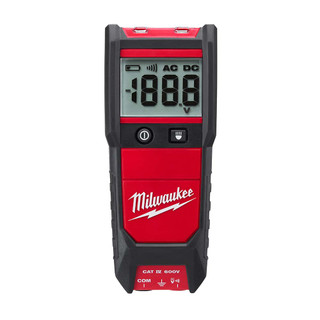
Milwaukee Digital Detectors, Sensors & Testing
Checking a circuit or tracing a fault? Milwaukee detectors help you investigate before work starts.
Milwaukee digital detectors and testing equipment cover different jobs, so match the instrument to the measurement, voltage and working environment. For sparks and maintenance teams, the right rating and compatible probes matter more than extra functions. Choose your tester around the checks you actually carry out.
What Are Milwaukee Detectors and Testers Used For?
- Trace electrical faults in equipment and control circuits using a suitably rated multimeter to check voltage, resistance and continuity, following the correct procedure for each measurement.
- Measure current on accessible individual conductors with a compatible clamp meter, choosing AC or AC/DC capability to suit the installation.
- Make an initial check for the possible presence of AC voltage with a non-contact voltage tester before carrying out the appropriate contact tests.
- Locate concealed framing before fixing cabinets or brackets with a suitable stud detector, checking its stated detection capability against the wall construction.
- Investigate uneven heating, insulation gaps or unusually warm components with a thermal imager, then confirm the cause through further inspection and testing.
Choosing the Right Milwaukee Detectors
Buy for the test you need to carry out, not simply for the number of functions on the dial.
1. Match the Instrument to the Job
If you need voltage, resistance and continuity measurements, start with a suitable multimeter. If you regularly measure load current, consider a clamp meter with the right current functions. A non-contact voltage tester is an initial indicator, not a replacement for either instrument or for safe isolation equipment.
2. Check the Measurement Category and Voltage
For electrical work, match the instrument's CAT rating and voltage limit to the installation and test location. Check the leads, probes and fitted accessories as well: the lowest-rated part limits the assembled test setup.
3. Check AC, DC and Measurement Limits
If the job involves DC current, do not buy an AC-only clamp meter. Check current range, resolution and jaw opening before ordering. For distorted AC waveforms, look for true-RMS measurement and check the instrument's stated operating limits.
4. Check Detection Depth and Material Limits
For concealed framing or services, read what the detector can actually identify and through which materials. Foil-backed board, metal mesh, moisture and wall thickness can affect results. Do not treat a clear display as permission to drill without further checks.
Who Uses Milwaukee Testing Equipment?
Electricians and maintenance sparks use Milwaukee testing equipment to investigate supply problems, check components and measure current during fault-finding. Heating engineers and facilities teams use suitable temperature instruments to investigate heating performance, while kitchen fitters and joiners use stud detectors to help locate framing before fixing. Each needs an instrument suited to the task; one detector will not cover every check.
The Basics: Understanding Milwaukee Detectors and Testers
Detection, measurement and thermal imaging give you different information. Knowing the difference stops you relying on the wrong result.
1. Detection Is Not Proof of Isolation
A non-contact voltage tester senses an electric field associated with AC voltage. Shielding, cable depth and other conditions can prevent an indication. Proving dead requires suitable contact-testing equipment and a safe isolation procedure, including proving the tester before and after use.
2. Clamp Meters Need the Right Conductor
For ordinary load-current measurement, the clamp goes around one conductor. Clamping around a complete cable containing both line and neutral normally causes their magnetic fields to cancel, rather than giving the load reading you need.
3. Thermal Imagers Show Surface Temperatures
A thermal imager displays patterns of infrared radiation from surfaces. It can help locate an unusual hot spot or cold patch, but it does not see through walls or identify the fault on its own. Reflective finishes and surface settings can affect the reading.
Accessories for Reliable Electrical Testing
Keep the right leads, proving equipment and protection with your tester so damaged or unsuitable accessories do not stop the job.
1. Compatible Test Leads and Probes
Replace split insulation, damaged probe guards or loose connectors before testing. Choose manufacturer-approved leads with suitable voltage, current and CAT ratings, and probe protection appropriate to the work.
2. Compatible Proving Unit
For safe isolation work, a suitable proving unit lets you check that your voltage indicator operates before and after proving dead. Confirm compatibility with the indicator; a proving unit does not replace calibration or make an unsuitable tester acceptable.
3. Protective Instrument Case
Keep the meter and leads out of the loose fixings and masonry dust in the tool bag. A properly sized case protects the display and connections, while keeping probes together for the next call-out.
Choose the Right Milwaukee Testing Equipment for the Job
Start with the measurement or detection task, then check the individual model's specification.
| Your Job | Instrument Type | Key Features |
|---|---|---|
| Fault-finding on electrical equipment | Milwaukee multimeter | Required voltage and resistance ranges, continuity function and suitable CAT rating. |
| Checking load current on a conductor | Milwaukee clamp meter | AC or AC/DC current measurement, suitable jaw opening and useful low-current resolution. |
| Initial indication of possible AC voltage | Milwaukee non-contact voltage tester | Detection range suited to the supply; not suitable for proving dead. |
| Locating framing before fixing | Milwaukee stud detector | Supported materials, detection depth and suitability for the wall construction. |
| Investigating surface temperature differences | Milwaukee thermal imager | Thermal resolution, temperature range and image-recording capability where required. |
Common Buying and Usage Mistakes
- Using a non-contact tester to declare a circuit dead can leave dangerous voltage undetected. Use suitable safe isolation equipment and follow the correct procedure.
- Buying on maximum voltage alone overlooks the measurement category. Check both CAT rating and voltage against the test location, including the leads and probes.
- Choosing an AC-only clamp for DC current work leaves you without the measurement you need. Confirm the current functions rather than assuming DC voltage capability includes DC current.
- Measuring voltage with a lead left in the current socket can create a short circuit. Check the sockets, selected function and lead condition before connecting.
- Drilling after one clear detector pass ignores concealed-service detection limits. Check plans where available, scan as instructed and use further investigation where the route remains uncertain.
Multimeter vs Clamp Meter vs Non-Contact Voltage Tester
Multimeter: Detailed Fault-Finding
Choose a multimeter for contact measurements such as voltage, resistance and continuity. Current measurement through test leads requires the correct connection method and strict observance of the input limits; it is not as straightforward as clamping an accessible conductor.
Clamp Meter: Load-Current Checks
Choose a clamp meter when measuring current without opening the circuit is the main task. You still need safe access to an individual conductor, and the model must support the current type and range. Additional multimeter functions vary.
Non-Contact Voltage Tester: Initial Indication
Choose this for a quick indication of possible AC voltage within its specified range. It does not provide a measured voltage value, test continuity or prove that a conductor is safe to touch.
Maintenance and Care
Inspect Before Connecting
Check the casing, sockets, leads and probe insulation before use. Remove damaged equipment from service rather than covering a split lead with tape.
Keep Sensors and Connections Clean
Disconnect leads and switch off before cleaning as instructed. Keep clamp mating faces free from debris, and clean thermal lenses only with the recommended materials.
Protect During Storage
Store instruments dry in a protective case, with leads loosely coiled rather than tightly wrapped around the body. Follow the battery-removal guidance for long periods out of use.
Arrange Accuracy Checks and Repairs
Set calibration intervals around the manufacturer's guidance, workload and quality requirements. After a heavy drop or suspect reading, have the instrument assessed. Replace fuses only with the exact specified type and rating.
Why Shop for Milwaukee Detectors at ITS?
Shop the full Milwaukee detectors and testing equipment range stocked by ITS, with instrument types and specifications for electrical fault-finding, detection and maintenance checks. Stock is held in our own warehouse, ready for next-day delivery. Check individual product pages for current availability, included accessories and delivery options before ordering.
Milwaukee Detectors and Testing Equipment FAQs
What testing equipment does Milwaukee make?
Milwaukee's test and measurement ranges include multimeters, clamp meters, voltage detectors and temperature instruments. Milwaukee has also produced stud detectors and thermal imaging equipment. Model availability varies by market, so check the individual UK product listing for functions, specification and supply.
Is the Milwaukee multimeter good for electricians?
A suitably specified Milwaukee multimeter can cover electrical fault-finding tasks such as voltage, resistance and continuity checks. Choose by CAT rating, voltage limits, accuracy and required functions. It does not replace a multifunction installation tester where installation verification requires tests such as insulation resistance or earth fault loop impedance.
Does Milwaukee make a stud finder?
Yes, Milwaukee has produced stud finders and wall-scanning detectors, although availability differs between markets. Check the particular model's supported materials and detection depth. A stud indication does not establish that the fixing point is clear of cables or pipes.
What is the Milwaukee non-contact voltage tester used for?
It gives an initial indication of possible AC voltage without making an exposed electrical contact, within the model's specified detection range. It is useful during preliminary checks, but a lack of indication does not prove dead. Use suitable contact-testing equipment and the correct safe isolation procedure before work.
Do Milwaukee testers need calibrating?
Measuring instruments such as multimeters and clamp meters need accuracy checks and calibration at intervals suited to their use, manufacturer guidance and your quality procedures. There is no single interval for every tester. A voltage indicator also needs functional proving before and after proving dead; calibration does not replace that check.
Is a Milwaukee multimeter CAT rated?
Milwaukee electrical multimeters carry model-specific measurement category and voltage ratings. Read the markings and manual for the exact instrument rather than assuming all models are rated alike. Leads, probes and accessories must also suit the test location, and the lowest-rated component limits the setup.
Does Milwaukee make a thermal imaging camera?
Yes, Milwaukee has produced thermal imaging cameras, including M12-powered models. Check current UK availability and the exact specification before buying. A thermal imager shows surface temperature patterns; it does not see through plasterboard or confirm an electrical fault without further investigation.
Can a Milwaukee voltage tester detect live cables in walls?
A non-contact voltage tester may respond to some energised cables close to the surface, but it is not a dependable concealed-cable locator. Depth, shielding, foil-backed board and other conditions can prevent detection. Use a suitable service detector, check available plans and investigate uncertain routes before drilling; silence from a voltage tester does not mean the wall is clear.