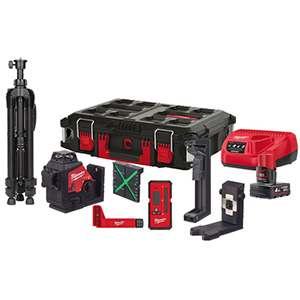
Milwaukee M12 Lasers, Detectors & Digital Measures
Setting out partitions or cabinet runs? A Milwaukee M12 laser level gives you a level reference without repeated marking.
Milwaukee M12 lasers suit fitters, sparkies and dryliners transferring lines around a room. Choose the beam layout first, then check working range, receiver compatibility and whether batteries are included. Shop the range to match your next fit-out.
What Jobs Are Milwaukee M12 Lasers Best At?
- Set out stud partitions with horizontal and vertical laser references, choosing a model with the coverage needed to carry your layout across walls, floors and ceilings.
- Align kitchen units and worktop supports along a consistent horizontal reference, rather than moving a spirit level between every fixing position.
- Mark socket heights and lighting positions during first fix, using the appropriate line or plumb-point layout to transfer your measurements.
- Establish tile courses across a bathroom or utility room, keeping the reference visible while you position battens and start laying.
- Pick up a compatible laser beam with a receiver when distance or bright conditions make the projected line difficult to see.
Choosing the Right Milwaukee M12 Laser Level
Buy the beam layout your work needs first; extra range will not make up for missing lines or plumb points.
1. Cross-Line or Multi-Plane Coverage
If you mainly fit cabinets or tile individual walls, a suitable cross-line layout may cover the work. If you set out partitions or need references on several walls without moving the tool, choose a model with the appropriate 360-degree planes. Check the actual beam diagram before ordering.
2. Visible Range or Receiver Range
For indoor fitting, check the stated visible working range. For bright spaces or longer distances, choose a receiver-compatible model and the receiver specified for it. Do not mistake the longer receiver-assisted range for a line you can see unaided.
3. Bare Unit or Complete Kit
If you already own compatible M12 batteries and a charger, a bare unit can avoid buying duplicates. If this is your first M12 tool, check that the package includes both. A product photograph showing a battery or case is not a substitute for the contents list.
4. Mounting and Adjustment
If you regularly work against steel framing, check the magnetic mounting arrangement and adjustment available. For rooms without suitable fixing points, plan for a compatible tripod or pole. Fine adjustment matters when you need to move a line a few millimetres without disturbing the whole setup.
Who Uses Milwaukee M12 Lasers?
Kitchen fitters and joiners use them to keep cabinet runs and internal fit-out work aligned. Sparkies use line and point references for socket heights and lighting layouts, while dryliners need suitable multi-plane coverage for partitions and ceilings. Maintenance teams already running M12 tools can share compatible batteries rather than carry another battery platform.
The Basics: Understanding Milwaukee M12 Lasers
The laser supplies a reference, not your finished measurement. Set the required height or position first, then use the projected lines to carry it through the work.
1. Self-Levelling Has Limits
The levelling mechanism corrects a small amount of tilt within the model's specified range. It cannot compensate for an unstable stand or a badly angled setup. Check the out-of-level indication and let the lines settle before marking.
2. Beam Layout Controls Coverage
Cross lines give horizontal and vertical references over a defined area. Models with 360-degree planes carry references around the room, while plumb points, where fitted, transfer positions between floor and ceiling. These features are not interchangeable, so choose against the layout you actually need.
3. A Receiver Finds the Beam
A compatible laser receiver indicates where the beam meets its sensing window when you cannot see the line clearly. It does not make the projected line brighter. Match the receiver to the exact laser model and follow its operating instructions.
Accessories for Setting Out with M12 Lasers
Sort the mounting, power and beam detection before you arrive at a room with nowhere suitable to stand the laser.
1. Compatible Tripod or Laser Pole
A stable support saves balancing the laser on stacked materials. Check the mounting thread, working height and load capacity against your tool and mounting bracket.
2. Compatible Laser Receiver
A matched receiver saves guessing at a faint line in bright conditions. Confirm compatibility with the exact laser rather than buying on beam colour alone.
3. Spare M12 Battery and Charger
A charged spare prevents setting-out work stopping halfway through a fit-out. Check runtime for the selected laser, battery capacity and number of active beams; do not assume every M12 battery gives the same working time.
Choose the Right Milwaukee M12 Laser for the Job
Match the line arrangement and package contents to how you work.
| Your Job | Laser Type or Package | Key Features |
|---|---|---|
| Aligning cabinets or tiling a wall | Cross-line model | Horizontal and vertical references, suitable visible range and fine positioning. |
| Setting out partitions across a room | Multi-plane model | Required horizontal and vertical 360-degree coverage with fewer repositioning stops. |
| Transferring positions from floor to ceiling | Model with suitable plumb references | Specified plumb points or intersecting planes appropriate to the layout. |
| Working over longer distances in bright conditions | Receiver-compatible laser and matched receiver | Confirmed compatibility and sufficient receiver-assisted working range. |
| Starting without existing M12 batteries | Milwaukee M12 laser kit | Check for an included battery, charger, mounting accessories and case. |
Common Buying and Usage Mistakes
- Buying on beam colour alone can leave you without the vertical planes or plumb references the job needs. Check the beam layout before comparing brightness.
- Reading receiver range as visible range leads to disappointment in bright rooms or outside. Check both figures and budget for a compatible receiver where needed.
- Assuming every package includes power can leave a bare unit unusable on arrival. Read the supplied contents for the battery and charger separately.
- Setting up on loose boards or a walkway lets movement shift your reference. Use a stable support and recheck the line if the tool or stand is knocked.
- Trusting self-levelling after a drop risks carrying an error through the whole fit-out. Complete the manufacturer's accuracy checks before using it for critical setting out.
Cross-Line vs Multi-Plane vs Line-and-Point Lasers
Cross-Line Lasers
Choose these for straightforward horizontal and vertical alignment on walls. They suit cabinet fitting and tiling, but limited coverage can mean repositioning when the job extends around a room.
Multi-Plane Lasers
Choose the appropriate 360-degree plane layout for room-wide references and partition setting out. They reduce repositioning, but the extra coverage is unnecessary if you only need a reference on one wall.
Line-and-Point Lasers
Choose a model combining lines with dedicated points when transferring positions is a regular part of first fix. Check which points are provided; point references do not replace continuous lines around a room.
Maintenance and Care
Keep Beam Windows Clean
Remove loose dust gently and clean the windows as instructed, using a suitable soft cloth. Do not scrape off plaster or wipe abrasive grit across the optics.
Protect It in Transit
Use the transport lock where fitted and secure the laser in a suitable case. Leaving it loose beneath drills and fixings in the van invites damage to the windows, mounts and housing.
Check Accuracy After Knocks
Follow the model's horizontal, vertical and plumb checking procedures as applicable. If it falls outside tolerance, stop using it for setting out and arrange service rather than trying to compensate by eye.
Dry Before Storage
Wipe off moisture and let the tool and case dry before closing them away. Keep battery contacts clean and follow the battery storage instructions when the kit is out of use.
Why Shop for Milwaukee M12 Lasers at ITS?
ITS stocks the full Milwaukee M12 laser range, covering different beam layouts, bare units and kits, alongside compatible receiver options. Stock is held in our own warehouse, ready for next-day delivery. Check the selected model's contents and current availability before ordering so the right kit arrives together.
Milwaukee M12 Laser Level FAQs
Are Milwaukee M12 lasers rechargeable?
Yes. M12 lasers run on removable, rechargeable Milwaukee M12 batteries. Charge the battery using a compatible charger, and check the package contents because bare units do not include a battery or charger.
Is a green M12 laser better than red?
A green beam is generally easier to see than red under comparable conditions, which helps when marking across bright interiors. It is not automatically more accurate, and direct sunlight can still make it difficult to see. Choose by accuracy, beam layout and working range as well as colour.
What is the range of a Milwaukee M12 laser?
It depends on the model and whether you use a receiver. Some M12 green line lasers specify up to 38 metres of visible working range, with a longer range available using a compatible receiver. Check the individual specification: lighting conditions affect visibility, and receiver-assisted figures are not unaided viewing distances.
Does the M12 laser come with a battery?
Not every package does. Bare units are intended for buyers who already have compatible M12 batteries, while kits may include a battery and charger. Check the exact contents list, including battery capacity, rather than assuming all packages with the same laser contain the same accessories.
Can the M12 laser be used with a detector?
Receiver-compatible M12 lasers can be used with the detector specified for that model. Do not assume any green-beam detector will work. A laser receiver detects the projected beam; it is not a wall scanner for finding cables, pipes or studs.
How accurate are Milwaukee M12 lasers?
Several M12 line laser models specify accuracy of ±0.3 millimetres per metre, equivalent to ±3 millimetres over 10 metres. Confirm the rating for your chosen model, including any separate plumb-point specification. Accuracy also depends on a sound setup and a tool that remains within calibration, so check it after a knock.
Do M12 lasers come with a case?
Some packages include a case, but case type and inclusion vary by product code. Read the supplied contents before ordering. If you need it to fit an existing storage system, check that the specified case is compatible rather than assuming every Milwaukee case connects to it.
Can M12 lasers be mounted to a tripod?
Yes, using the mounting provision specified for the model. Check the thread size on the laser or bracket against the tripod; an adaptor may be needed. Choose a stable tripod with enough height adjustment for the work, and keep it clear of walkways where a knock could shift your reference.