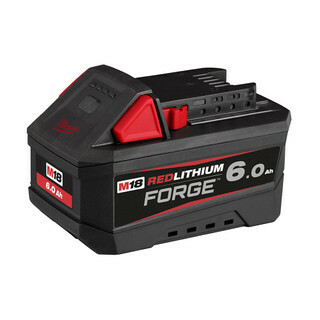
Milwaukee FORGE Batteries, Chargers and Mounts
Running grinders and saws hard all day? A Milwaukee FORGE battery supplies power for demanding M18 tools.
For chippies, fabricators and site teams, capacity affects runtime, weight and charging downtime. Match the pack to the tool, check charger compatibility, and choose Milwaukee FORGE batteries and chargers that suit your workload.
What Are Milwaukee FORGE Batteries and Chargers Used For?
- Power M18 circular saws through repeated cuts in structural timber, choosing enough battery capacity to limit charging stops during first fix.
- Run compatible M18 grinders on steel fabrication and fitting jobs where sustained cutting and grinding put heavy demands on the battery.
- Keep compatible M18 breakers and larger drilling tools supplied with power when working away from a mains connection.
- Rotate packs through a compatible high-output charger during busy shifts, reducing the time spent waiting for batteries between tasks.
- Secure spare batteries on correctly fitted mounts in the workshop or van, rather than leaving them loose among fixings and hand tools.
Choosing the Right Milwaukee FORGE Battery
Buy for the tool's workload and the weight you can comfortably handle, not just the biggest Ah figure.
1. Choose Capacity Around the Job
For handheld work where weight matters, start by comparing the Milwaukee FORGE 6Ah battery with the larger packs. The Milwaukee FORGE 8Ah battery offers more capacity without stepping up to 12Ah. Choose a Milwaukee FORGE 12Ah battery for longer runs on demanding tools where its extra size and weight are manageable.
2. Match the Charger to Your Turnaround
If you regularly empty packs faster than your existing charger replenishes them, consider the Milwaukee dual bay super charger. A standard compatible M18 charger still charges FORGE batteries, but it will not deliver the fastest advertised charging times. Check the pack-and-charger charging table before buying.
3. Check Cooling Compatibility
If you are working packs hard and charging them repeatedly, check for COOL-CYCLE compatibility on both the battery and charger. Do not assume every FORGE pack has the same cooling arrangement or that any charger can provide active battery cooling.
4. Check Mount Fit and Retention
For van storage, choose mounts specified for your M18 battery and intended mounting position. Check clearance around larger packs, use suitable fixings, and confirm the retention method is appropriate for vehicle use. A storage mount does not charge the battery.
Who Uses Milwaukee FORGE Batteries?
Chippies running M18 saws, steel fabricators using grinders, and mechanical installers drilling repeated fixing holes benefit from packs designed for demanding loads. Maintenance teams already using M18 tools can share FORGE batteries across compatible kit, while workshop and van-based crews use dedicated mounts to keep charged packs organised.
The Basics: Understanding Milwaukee M18 FORGE Batteries
Capacity, power delivery and charging speed are different things. Understanding the difference stops you buying a larger pack when a different battery or charger would solve the problem.
1. Ah Measures Capacity, Not Cutting Power
The Ah rating describes battery capacity. Under comparable conditions, a higher-capacity pack generally runs longer, but the figure alone does not tell you how well it supplies a heavily loaded saw or grinder. Battery construction, temperature and the tool itself also affect performance.
2. FORGE Stays Within the M18 System
A Milwaukee M18 FORGE battery fits the M18 cordless system. Its higher-output design is most relevant on tools drawing substantial power; it does not change their voltage or increase their rated speed. M18 packs do not fit M12 battery slots.
3. Fast Charging Depends on the Whole Setup
The battery, charger and pack temperature determine charging speed together. COOL-CYCLE uses active cooling with compatible equipment to help manage heat and reduce downtime. It does not mean a hot battery will always begin charging immediately.
Accessories to Keep FORGE Batteries Organised
Protect spare packs and give your charging setup a proper place in the van or workshop.
1. Compatible M18 Battery Mounts
Dedicated mounts stop packs rolling around drawers and make missing batteries easier to spot before leaving the yard. Check fit, retention and clearance for the specific FORGE pack before fixing them in place.
2. Battery Storage Cases
A suitable case keeps spare packs separate from loose screws, metal offcuts and wet kit. Choose compartments large enough for your batteries so terminals cannot contact conductive objects during transport.
Choose the Right Milwaukee FORGE Battery Setup for the Job
Match capacity, charging speed and storage to the way your crew works.
| Your Job | Battery or Equipment | Key Features |
|---|---|---|
| Handheld cutting and drilling where pack weight matters | M18FB6 FORGE 6Ah | Lower capacity and less bulk than the larger FORGE options; check the complete tool's balance. |
| Repeated cuts and fixing work across a busy shift | M18FB8 FORGE 8Ah | More capacity than 6Ah, with COOL-CYCLE capability when paired with compatible charging equipment. |
| Longer runs on demanding saws and other high-draw tools | M18FB12 FORGE 12Ah | The highest capacity of these three options, with extra weight and space requirements. |
| Frequent battery changes across several M18 tools | Compatible dual bay super charger | Faster turnaround with supported packs; compare charging times for your exact batteries. |
| Keeping spare packs secure and easy to find | Compatible M18 battery mounts | Check pack clearance, mounting orientation, retention and suitable fixing points. |
Common Buying and Usage Mistakes
- Choosing 12Ah for every tool adds unnecessary weight to lighter drilling and fixing jobs. Reserve the larger pack for work where its runtime earns its place.
- Expecting super-charger speeds from an existing standard charger leads to disappointing turnaround. Check charging figures for the exact battery and charger combination.
- Treating power output and capacity as the same thing gives misleading comparisons. A smaller FORGE pack can supply strong output without matching a larger pack's runtime.
- Charging inside a shut toolbox or covering ventilation slots traps heat. Set the charger on a dry, stable surface with the clearance specified in its instructions.
- Leaving batteries loose with metal fixings risks terminal damage or a short circuit. Use suitable mounts or separate storage compartments.
Milwaukee FORGE 6Ah vs 8Ah vs 12Ah
FORGE 6Ah: Less Bulk for Handheld Work
Choose the M18FB6 when you want FORGE power delivery without carrying the largest pack. It suits frequent handling and battery rotation, but has less stored energy than the 8Ah and 12Ah options.
FORGE 8Ah: Extra Capacity Without Going to 12Ah
The M18FB8 suits crews moving between demanding handheld tools who want more runtime than 6Ah. It offers a middle option on capacity, but still needs checking for balance on smaller tools.
FORGE 12Ah: Capacity for Longer Runs
Choose the M18FB12 where fewer battery changes matter more than keeping weight down. It is better suited to demanding applications and tools that support its bulk than to light fixing work.
Maintenance and Care
Keep Contacts and Vents Clean
Remove batteries and unplug the charger before cleaning. Use a dry cloth or soft brush to remove surface dust, keeping liquids and metal tools away from contacts and ventilation openings.
Store Away from Heat and Damp
Keep packs in a dry place away from direct sunlight, heaters and loose metal objects. Follow the battery instructions for storage temperature and charge level when putting kit away for an extended period.
Inspect After Drops or Heavy Knocks
Check the casing, contacts and retaining catches before reuse. Stop using a pack with cracks, swelling, leakage or unusual heat, and arrange assessment through an authorised service route rather than opening it yourself.
Check Chargers and Mounts
Inspect charger leads for damage and keep cooling openings clear. Periodically check mount fixings and retention, particularly in vans where vibration can loosen fittings.
Why Shop for Milwaukee FORGE Batteries at ITS?
ITS stocks the Milwaukee FORGE battery range, including 6Ah, 8Ah and 12Ah options, alongside compatible chargers and mounts. Stock is held in our own warehouse, with in-stock items ready for next-day delivery. Check availability, delivery eligibility and the order cut-off before arranging your next job.
Milwaukee FORGE Battery FAQs
How fast does a Milwaukee Forge battery charge?
It depends on the pack and charger. Milwaukee quotes an 80% charge in 15 minutes for the M18 FORGE 6Ah with the M18 dual bay super charger under specified conditions. That is not a full-charge time, and larger packs have different charging figures. Battery temperature and starting charge also affect turnaround.
Which charger is best for Milwaukee Forge batteries?
For rapid turnaround across several heavily used packs, the compatible M18 dual bay super charger is the practical choice. For occasional use, an existing compatible M18 charger may be sufficient. Check the exact charger's charging table and COOL-CYCLE support rather than relying on the word "fast".
Is the Milwaukee Forge 6Ah better than a standard 12Ah?
For weight and power delivery, it can be the better choice. Milwaukee rates the FORGE 6Ah as delivering the power of its M18 HIGH OUTPUT 12Ah in a smaller, lighter pack. It does not have the same capacity: under comparable conditions, the 12Ah stores more energy and generally runs longer. Choose around the tool and task, not the power claim alone.
Do Milwaukee Forge batteries get hot?
Yes. Sustained grinding, heavy sawing and charging generate heat, even with advanced battery management. Compatible COOL-CYCLE equipment helps manage that heat, but does not keep a pack cold. Follow temperature warnings and stop using any battery showing unusual heat, damage or swelling.
How long do Milwaukee Forge batteries last?
There is no useful single runtime figure across M18 tools. Cutting load, material, tool condition, temperature and pack capacity all matter. Service life also depends on charging habits, heat exposure and physical treatment; a fixed number of working years would be misleading. Compare runtime using the same tool and task.
What does Cool-Cycle mean on Milwaukee Forge batteries?
COOL-CYCLE is Milwaukee's active cooling system for compatible batteries and chargers. It moves cooling air through the supported battery arrangement to help reduce heat-related downtime. Both parts must support the system; a FORGE label alone does not mean every battery-and-charger pairing provides COOL-CYCLE cooling.
What is the warranty on Milwaukee Forge batteries?
Check the current Milwaukee UK warranty terms for the exact battery before buying, including any registration deadline and extended-cover eligibility. Do not assume a tool warranty automatically covers its batteries on identical terms. Keep your proof of purchase and register eligible products promptly; normal wear, misuse and accidental damage are not the same as a manufacturing defect.
Can you charge a Milwaukee Forge battery on a standard M18 charger?
Yes. M18 FORGE batteries are compatible with M18 chargers, so upgrading the pack does not automatically mean replacing your charger. A standard charger will not provide the fastest FORGE charging times or cooling features it does not support. Use the charging table for your exact models to judge whether an upgrade is worthwhile.