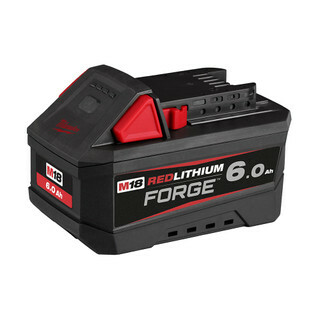
Milwaukee FORGE
When a grinder or saw keeps stopping for battery swaps, Milwaukee FORGE batteries give demanding M18 tools more headroom.
The Milwaukee M18 FORGE range suits sustained cutting, drilling and grinding, with pack sizes for different workloads. Match capacity to the tool, check your charger, then choose the pack that keeps the job moving.
What Jobs Are Milwaukee FORGE Batteries Best At?
- Cut structural timber and sheet materials with M18 saws, choosing enough battery capacity to reduce trips back to the charger during first fix.
- Grind steelwork and prepare welds with compatible M18 grinders, where a battery capable of supplying higher current helps under sustained load.
- Drill repeated holes through masonry with M18 rotary hammers, matching pack size to hole diameter, workload and how much weight you can comfortably handle.
- Run demanding M18 outdoor equipment during grounds maintenance, using higher-capacity packs where runtime matters more than keeping the tool light.
Choosing the Right Milwaukee FORGE Battery
Buy for the tool and the length of the task, not simply the biggest Ah figure.
1. Keep Weight Sensible with 6Ah
If you move between drilling, cutting and fitting, consider the Milwaukee FORGE 6Ah before adding a larger pack. It delivers the power of Milwaukee's M18 HIGH OUTPUT 12Ah battery in a smaller, lighter package, but it does not carry the same energy for runtime.
2. Choose 8Ah for More Time Between Swaps
If a saw or grinder sees regular use throughout the shift, the Milwaukee FORGE 8Ah gives you more stored energy than the 6Ah. Check the complete tool weight before choosing it for repeated overhead drilling or awkward access.
3. Put 12Ah on the Longer Jobs
If you are making extended cuts or running demanding equipment for longer periods, consider the Milwaukee FORGE 12Ah. Its extra capacity makes more sense on those jobs than on a compact driver used for occasional screws.
4. Check Your Charging Setup
If batteries are queuing for your existing charger, another large pack will only solve part of the problem. Compare the published charge times for your chosen battery and charger combination; the fastest FORGE charging and active cooling require compatible equipment.
Who Uses Milwaukee FORGE Batteries?
Chippies running cordless saws, steel fabricators using grinders, and installers drilling repeated fixings reach for Milwaukee FORGE when their M18 tools spend more time under load. Maintenance and grounds teams also use larger packs for longer tasks, while fitters working overhead need to balance extra runtime against the weight on the tool.
The Basics: Understanding Milwaukee FORGE Batteries
Milwaukee REDLITHIUM FORGE batteries belong to the M18 system, but capacity, power delivery and charging speed are separate things. Keep those differences clear when comparing packs.
1. Ah Measures Capacity, Not Cutting Power
At the same nominal voltage, a higher Ah rating means more stored energy. It does not tell you everything about the current a pack can supply under load. FORGE battery construction allows strong power delivery without simply increasing capacity.
2. The Tool Still Sets the Limit
A demanding M18 tool can benefit from a battery that supplies higher current, but a FORGE pack does not change its gearing, rated speed or safety limits. Expect the clearest benefit where the existing battery is restricting performance under load.
3. Cooling Affects Charging Turnaround
A hot battery may need to cool before charging proceeds at full speed. COOL-CYCLE active cooling works with compatible batteries and chargers to manage heat; it is not a feature of every M18 charging combination.
Charging and Storage Kit for Milwaukee FORGE
Sort charging capacity and protected transport before adding more batteries to the van.
1. Compatible M18 Dual Bay Super Charger
A suitable dual bay charger reduces the bottleneck when several packs come back flat together. Check battery-specific charge times and COOL-CYCLE compatibility rather than assuming every M18 charger delivers the same turnaround.
2. Secure Battery Storage
Use a battery holder or suitable storage case that keeps packs secure and terminals away from loose fixings. It stops charged batteries rolling around with screws, metal offcuts and wet tools in the van.
Choose the Right Milwaukee FORGE Battery for the Job
Start with the workload, then check weight and charging time.
| Your Job | Battery Choice | Key Features |
|---|---|---|
| Mixed drilling and cutting with frequent tool changes | Milwaukee FORGE 6Ah | High power delivery in a smaller, lighter package than the M18 HIGH OUTPUT 12Ah. |
| Regular sawing and grinding throughout the shift | Milwaukee FORGE 8Ah | More stored energy than the 6Ah; check handling on the intended tool. |
| Extended cutting or demanding grounds maintenance | Milwaukee FORGE 12Ah | The highest capacity of these three options, with extra size and weight to consider. |
| Keeping several demanding tools supplied | Rotating FORGE packs with a compatible fast-charging setup | Match spare battery capacity and charging speed to actual consumption. |
Common Buying and Usage Mistakes
- Buying 12Ah for every tool adds unnecessary weight to small drilling and screwdriving jobs. Save larger packs for equipment that benefits from the capacity.
- Treating Ah as a power rating gives a misleading comparison. Check the battery's stated power performance as well as its capacity.
- Expecting headline charging times from an older charger leads to avoidable downtime. Check the exact battery and charger pairing before ordering.
- Assuming M18 compatibility includes M12 tools leaves you with the wrong battery. FORGE M18 packs fit the M18 system, not M12 battery connections.
Milwaukee FORGE vs HIGH OUTPUT vs Standard REDLITHIUM
Milwaukee FORGE
Choose FORGE when demanding M18 tools need strong power delivery and charging turnaround matters. The higher purchase cost is harder to justify for occasional light-duty work, and performance gains depend on the tool and pack being compared.
Milwaukee HIGH OUTPUT
HIGH OUTPUT remains a practical option for demanding tools, particularly if your existing packs already cover the workload. Compare equivalent models carefully: FORGE can provide comparable or greater power from a different-sized pack.
Standard Milwaukee REDLITHIUM
Standard packs can be the sensible buy for screwdriving, lighter drilling and intermittent maintenance. Compact versions keep tool weight down, but they are not the first choice for sustained work with high-demand saws or grinders.
Maintenance and Care
Keep Connections Clean
Remove the pack from the tool before cleaning. Wipe the casing with a dry cloth and keep terminals and ventilation openings clear of debris; do not wash or immerse the battery.
Store Away from Heat and Damp
Keep packs dry and away from direct heat, loose metal and unsecured loads. Follow Milwaukee's temperature and charge-level guidance when storing batteries for longer periods.
Check After Heavy Impacts
Inspect the casing, latch and terminals after a drop. Stop using a pack with cracks, swelling, damaged contacts or unusual heat, and seek authorised advice rather than opening it.
Use the Correct Charger
Charge with a compatible Milwaukee charger in a dry, ventilated location. Keep charger vents clear and follow any fault indication instead of repeatedly removing and reinserting a suspect battery.
Why Shop for Milwaukee FORGE at ITS?
ITS stocks the Milwaukee FORGE range, covering 6Ah, 8Ah and 12Ah M18 batteries alongside compatible charging options. Stock is held in our own warehouse, ready for next-day delivery on available items. Check the individual listing for current availability, order cut-off and delivery to your postcode.
Milwaukee FORGE FAQs
What is Milwaukee Forge?
Milwaukee FORGE is a high-performance REDLITHIUM battery range. The M18 FORGE packs covered here supply 18V Milwaukee tools, with battery technology designed for strong power delivery, durability and faster charging when paired with suitable chargers.
Are Milwaukee Forge batteries worth it?
They make most sense if you regularly load up M18 saws, grinders or other demanding equipment. If you mainly drive screws or drill occasional small holes, a lighter, lower-cost pack may cover the job. Upgrade where battery performance or charging downtime is actually holding you up.
Do Milwaukee Forge batteries work with all M18 tools?
Yes. Milwaukee M18 FORGE batteries are compatible with all M18 tools. That does not mean every tool gains the same performance benefit; demanding equipment has more opportunity to use the extra power delivery than a lightly loaded driver.
What is the difference between Milwaukee Forge and High Output?
FORGE uses newer battery technology to improve power delivery and charging performance compared with relevant HIGH OUTPUT packs. The difference depends on the models: the FORGE 6Ah delivers the power of the HIGH OUTPUT 12Ah in a smaller, lighter pack, but with less stored energy.
Do I need a special charger for Milwaukee Forge batteries?
No. M18 FORGE batteries work with Milwaukee M18 chargers. You do need the appropriate charger to achieve the fastest published charging times, and COOL-CYCLE active cooling requires a compatible battery and charger combination. Check the pairing before paying for a charging upgrade.
How much power does a Milwaukee Forge battery deliver?
There is no single power figure for the whole range. All these packs belong to the 18V M18 system, while current delivery varies by model. Milwaukee states that the FORGE 6Ah delivers the power of its HIGH OUTPUT 12Ah; Ah alone is not a measure of power.
Are Milwaukee Forge batteries heavier than standard batteries?
Not necessarily; compare specific packs rather than the range names. The FORGE 6Ah is smaller and lighter than the HIGH OUTPUT 12Ah while delivering comparable power. A compact standard M18 pack can still be lighter, so check listed weights if handling or overhead work is your main concern.
Do Milwaukee Forge batteries work in older M18 tools?
Yes. M18 FORGE batteries are backwards compatible with older M18 tools. They do not convert other Milwaukee voltage platforms to M18, and an older tool's motor and electronics still determine its operating limits. Choose capacity for the workload rather than expecting the battery to transform the tool.