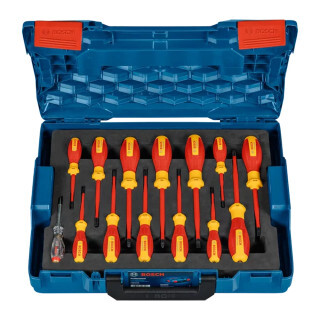
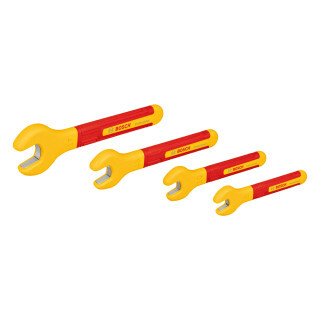
Bosch VDE Fastening Tools
Working on electrical terminals and fixings? Bosch VDE fastening tools provide insulated options for tightening and loosening them.
Bosch VDE screwdrivers and spanners suit electrical installation and maintenance work. Match the tip or jaw size properly, check the insulation before use, and isolate the supply. Choose the tools your fittings actually need.
What Are Bosch VDE Fastening Tools Used For?
- Tighten terminal screws in distribution boards and control panels with the correct screwdriver profile, following the equipment manufacturer's torque requirements.
- Remove enclosure screws during isolated maintenance work without chewing up the heads with a poorly fitting driver.
- Hold and turn accessible hexagonal nuts on electrical assemblies with an insulated spanner matched to the exact nut size.
- Replace damaged electrical components during planned shutdowns, using insulated fastening tools alongside the required isolation and proving-dead procedure.
Choosing the Right Bosch VDE Fastening Tools
Buy for the fasteners you work on, not simply the number of tools in the box.
1. Match the Screw Head Exactly
If you're working on terminals, identify the specified drive profile before buying. Slotted, Phillips and Pozidriv tips are not interchangeable. Start with Bosch VDE Screwdriver Sets for several regular sizes, but check the actual contents rather than assuming every terminal type is covered.
2. Buy Singles for Gaps and Replacements
If one frequently used tip is worn, replace that driver rather than buying another complete set. Bosch VDE Individual Screwdrivers also let you add a specific blade size or shaft length. Check that both the tip and insulated shaft will reach a recessed fixing.
3. Check Spanner Size and Working Clearance
For accessible hexagonal nuts, choose Bosch VDE Spanners in the exact across-flats size. Allow room for the insulation around the head; a spanner that fits the nut may still be too bulky for a closely packed assembly.
4. Separate Insulation from Torque Control
A VDE screwdriver does not automatically limit tightening torque. If the terminal manufacturer specifies a torque, use a suitable torque-controlled tool with the correct drive and insulation rating. Tightening by feel is not a substitute.
Who Uses Bosch VDE Fastening Tools?
Electricians use these tools for terminal connections, enclosure fixings and electrical installation work. Panel builders and maintenance sparks need accurately fitting drivers and spanners when assembling or servicing electrical equipment. For a broader installation kit, look at Bosch VDE Hand Tool Kits and check the contents against the jobs you regularly take on.
The Basics: Understanding VDE Fastening Tools
VDE insulation is an electrical protection feature, not simply a comfortable handle covering. Read the markings on each tool and understand the limits before putting it into service.
1. Check the Tool's Certification and Rating
Look for the applicable IEC 60900 markings, VDE certification and voltage rating. Bosch VDE hand tools commonly carry ratings up to 1,000 V AC and 1,500 V DC, but the individual tool's markings and instructions are what count. An ordinary plastic-handled tool is not an equivalent.
2. Insulated Tools Do Not Replace Safe Isolation
Isolate, secure against reconnection and prove dead using the correct procedure. Insulated tools provide protection within their stated conditions; they do not make live working routine or remove the need for competence, risk assessment and suitable protective equipment.
Accessories for Keeping Insulated Tools Protected and Visible
Protect the insulation between jobs and make sure you can see the fixing clearly before choosing a driver.
1. Protective Tool Roll or Case
Separate compartments stop insulated shafts rubbing against loose drill bits, knives and other sharp kit in the bag. Choose storage that accommodates the tools without forcing or bending them.
2. Head Torch or Inspection Light
A clear view inside an isolated enclosure helps you identify the screw profile and seat the tip properly. Use suitable task lighting rather than trying to hold a phone while working on the fixing.
Choose the Right Bosch VDE Fastening Tools for the Job
Start with the fixing type, then check access, insulation and tightening requirements.
| Your Job | Tool Type | Key Features |
|---|---|---|
| Working across several terminal and enclosure screw sizes | VDE screwdriver set | Required drive profiles and sizes, clearly identified handles and suitable shaft lengths. |
| Replacing a worn driver used every day | Individual VDE screwdriver | Exact tip profile, correct blade dimensions and verified insulation rating. |
| Turning accessible hexagonal nuts on electrical assemblies | VDE spanner | Correct across-flats size and enough clearance around the insulated head. |
| Reaching screws inside narrow terminal recesses | Suitably sized VDE screwdriver | Insulated shaft diameter and reach that fit without modifying the tool. |
Common Buying and Usage Mistakes
- Treating any plastic handle as electrical insulation leaves you relying on an unverified tool. Check the certification, voltage marking and condition before use.
- Using the nearest-looking screwdriver tip damages screw heads and encourages slipping. Match the exact profile and size before applying force.
- Trimming insulation to reach a recessed fixing compromises the tool's protection. Buy a correctly sized insulated shaft instead.
- Assuming a standard VDE driver controls torque can leave terminals loose or damaged. Follow the equipment's tightening specification with an appropriate torque tool.
- Buying insulated sockets or hex keys on brand name alone risks getting an ordinary tool instead. Verify the certification of every item, including any extension or adaptor used with it.
VDE Screwdrivers vs VDE Spanners vs VDE Sockets and Hex Keys
VDE Screwdrivers
Choose these for matching terminal and enclosure screws. They give direct access along the screw's axis, but the tip must match precisely and a standard driver will not control torque.
VDE Spanners
Choose a spanner where you can approach a hexagonal nut from the side. It suits fixings where a socket cannot fit over the end, although you still need room to turn the handle.
VDE Sockets and Hex Keys
A socket fits over an external hexagonal nut or bolt head; a hex key fits an internal hexagonal recess. These are different tools for different fixings. If either is required, check current availability and certification rather than assuming a standard Bosch accessory is insulated.
Maintenance and Care
Inspect Before Every Use
Check handles and insulated shafts for cuts, splits, burns or exposed metal where insulation should be intact. Remove suspect tools from service; tape is not a repair for damaged VDE insulation.
Keep Insulation Clean
Remove dirt and grease using the cleaning method permitted by Bosch. Avoid aggressive solvents or abrasives that could attack the insulation, and dry tools before putting them away.
Protect Tools in Transit
Store tools in a dry case or roll, away from sharp edges, excessive heat and chemicals. Do not leave insulated drivers loose beneath heavy kit in the van.
Replace Worn Working Ends
Replace drivers with rounded tips and spanners with damaged jaws. Do not grind the working end or alter the insulation to keep a worn tool going; follow the manufacturer's inspection and replacement guidance.
Why Shop for Bosch VDE Fastening Tools at ITS?
ITS stocks the full Bosch VDE fastening tools range, covering screwdriver sets, individual replacements and spanner sizes for electrical installation and maintenance. Stock is held in our own warehouse, ready for next-day delivery, subject to availability, order cut-off and postcode. Browse the wider Bosch VDE range to put together the insulated kit your work requires.
Bosch VDE Fastening Tools FAQs
What fastening tools does Bosch make?
Bosch makes powered fastening tools and manual tools, including screwdrivers, spanners, ratchets and sockets across its wider ranges. For this category, focus on individually marked VDE tools. Do not assume every Bosch screwdriver, socket or hex key has electrical insulation.
Are Bosch fastening tools any good?
Bosch Professional VDE fastening tools are intended for professional electrical work, but the right specification matters more than the badge. Check certification, tip fit, access and condition. A correctly sized driver is useful; the wrong profile or damaged insulation makes it unsuitable regardless of brand.
What is the difference between a spanner and a socket?
A spanner grips a nut or bolt head with a fixed head and handle. A socket fits over the fixing and connects to a ratchet or other drive tool. An open-ended spanner allows side access, while a socket normally needs access over the end. For insulated work, check the rating of the complete tool combination, not just the socket.
Where are Bosch tools made?
Bosch manufactures tools in several countries, and the origin varies by product. Do not assume a Bosch tool is made in Germany. Check the packaging or product markings for the country of manufacture of the particular item you are buying.
Do Bosch tools come with a warranty?
Yes, Bosch tools come with warranty terms, but coverage and any extended guarantee depend on the product and current UK conditions. Check the terms for the exact hand tool and keep your proof of purchase. Normal wear, misuse and damaged insulation are not automatically covered, and an in-warranty tool must still be safe to use.
Can I use these on live equipment because they are VDE rated?
The rating is not permission to work live. Safe isolation and proving dead remain the normal approach. Any live work must meet the applicable legal requirements and be carried out by competent personnel using the required procedures and protection. Never use a tool with damaged insulation.