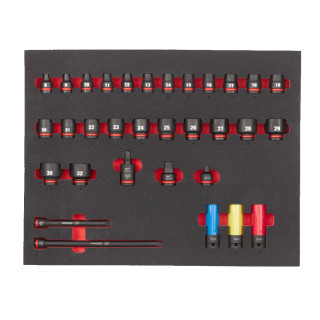
Milwaukee SHOCKWAVE Sockets & Socket Sets
Shifting stubborn nuts needs Milwaukee Shockwave sockets matched to your impact wrench, fastener size and access.
Milwaukee Shockwave sockets and socket sets cover repetitive fastening and maintenance work where ordinary hand sockets are unsuitable for impact loads. Check the drive size first, then choose standard or deep sockets to suit the job. Browse the range for your next fixing job.
What Jobs Are Milwaukee Shockwave Sockets Best At?
- Tighten nuts on threaded rod during mechanical and electrical installations, using deep sockets where the exposed thread prevents a standard socket seating fully.
- Remove stubborn nuts and bolts during plant maintenance with an impact-rated socket matched to the wrench drive and fastener size.
- Run down compatible hex-head fixings on brackets and support frames, then complete final tightening to the fixing manufacturer's specified torque.
- Work around machinery housings and vehicle components with standard-depth sockets where clearance is too tight for a deep socket.
Choosing the Right Milwaukee Shockwave Sockets
Start with your tool's drive size and the fasteners you actually use; a bigger socket set is no help if it does not fit either.
1. Match the Drive Connection
Check whether your tool has a square-drive anvil or a hex bit holder before ordering. Match a square-drive socket directly to the wrench wherever possible. An adaptor adds length and introduces another component with its own load limits.
2. Standard or Deep Sockets
Choose standard-depth sockets for exposed bolt heads and restricted clearance. Choose Milwaukee Shockwave deep sockets where a protruding stud prevents a shorter socket reaching the nut. Check usable internal depth rather than relying on overall length alone.
3. Useful Sizes Before Piece Count
For regular installation work, list your fixing sizes before comparing Milwaukee SHOCKWAVE Socket Sets. Check each set's contents: adaptors and extensions can count towards the total without adding another socket size.
4. Impact Suitability
For powered impact work, select sockets explicitly marked as impact rated. Compare Milwaukee SHOCKWAVE Impact Socket Sets by drive, size coverage and depth, not just the case layout.
Who Uses Milwaukee Shockwave Sockets?
Mechanical fitters and maintenance engineers use these sockets for repeated nut-and-bolt work on plant and machinery. Steel erectors and M&E installers use suitable sizes for brackets, frames and threaded supports. Vehicle technicians can replace missing or worn working sizes through the Milwaukee SHOCKWAVE Individual Impact Sockets range rather than buying another complete set.
The Basics: Understanding Impact Socket Connections
The socket must fit both ends of the job: your power tool at one end and the fastener at the other.
1. Drive Size Is Not Fastener Size
The square-drive measurement describes the connection to the wrench, not the nut it fits. A socket marked 19mm fits a 19mm fastener across the flats, but you still need to check its drive size separately.
2. Impact Rating Applies to the Whole Connection
Impact sockets withstand repeated hammering from an impact mechanism. Any extension or adaptor between the tool and socket must also be suitable for impact use; fitting an impact socket does not make an ordinary hand-tool extension safe for powered impacts.
Socket Accessories for Awkward Access
Check Milwaukee SHOCKWAVE Impact Socket Accessories when a direct connection will not reach or fit the job.
1. Impact-Rated Extension Bars
An extension helps reach recessed fasteners where the wrench body cannot get close enough. Use the shortest practical length, keep the socket square and check clearance before running the tool.
2. Impact-Rated Drive Adaptors
A suitable adaptor connects otherwise mismatched drive sizes without buying duplicate sockets for an occasional job. Check its load limits, particularly when reducing from a larger wrench drive; the adaptor does not increase the smaller socket's capacity.
Choose the Right Milwaukee Shockwave Sockets for the Job
Match socket depth, connection and size coverage to the work in front of you.
| Your Job | Socket Type | Key Features |
|---|---|---|
| Removing accessible nuts and bolts around machinery | Standard-depth impact socket | Correct square drive and fastener size, with less overall length than a deep equivalent |
| Tightening nuts with exposed stud above them | Deep impact socket | Sufficient internal clearance to seat fully over the nut |
| Covering several metric fixing sizes on installation work | Metric impact socket set | Required working sizes, suitable drive and organised storage |
| Replacing one missing or damaged working size | Individual impact socket | Matching drive, profile and depth without duplicating the whole set |
Common Buying and Usage Mistakes
- Buying by socket size alone can leave you with the right fit for the nut but the wrong connection for the wrench. Check both measurements before ordering.
- Choosing a deep socket for every job adds unnecessary length and can block access beside machinery housings. Use standard depth where the stud length allows it.
- Using a nearly matching metric or imperial size can damage the fastener corners. Clean the head and use the exact size with the socket fully seated.
- Treating an impact wrench setting as a verified final torque can leave fixings incorrectly tightened. Follow the installation specification and use a calibrated torque wrench where required.
Standard-Depth vs Deep Impact Sockets vs Hand Sockets
Standard-Depth Impact Sockets
Choose these for accessible fasteners and tighter working spaces. They keep the tool closer to the fixing, but may bottom out before reaching a nut on a long stud.
Deep Impact Sockets
Choose these for protruding studs and suitable recessed fixings. The extra depth helps access, but the longer socket needs more clearance behind the wrench.
Hand Sockets
Use hand sockets with manual ratchets for controlled assembly and servicing. Some have slimmer walls for restricted recesses, but non-impact-rated sockets must not be used on impact tools.
Maintenance and Care
Clear the Socket Recess
Brush out grit, swarf and packed dirt after use. Debris inside the socket can stop it seating fully and leave you driving on the edge of the fastener.
Dry Before Storage
Wipe sockets dry before returning them to the case. Apply a light protective oil where recommended and wipe off excess so it does not collect site dust.
Inspect for Impact Damage
Replace sockets showing cracks, distortion, badly worn internal flats or damaged drive recesses. Do not weld, heat or grind a damaged socket back into service.
Check Retention and Storage
Check the tool's retaining ring or pin arrangement and any socket retention components before use. Store sockets in size order so missing pieces are spotted before leaving for site.
Your Milwaukee Shockwave Socket Range, Ready to Go
ITS stocks the full Milwaukee Shockwave socket range, from individual replacement sizes to sets for regular fastening work. Compare Milwaukee SHOCKWAVE Power Tool Socket Sets alongside the drive sizes and depths your jobs need. Stock is held in our own warehouse, ready for next-day delivery; check the product's live availability and delivery options when ordering.
Milwaukee Shockwave Sockets FAQs
What are Milwaukee Shockwave sockets?
They are sockets in Milwaukee's SHOCKWAVE fastening range, designed for powered fastening applications. Select the correct connection, fastener size and depth for your tool and job rather than assuming every socket in the range fits the same wrench.
Are Shockwave sockets impact rated?
Milwaukee SHOCKWAVE impact sockets are impact rated. Check the individual product description for the intended tool connection, and use impact-rated extensions and adaptors throughout. An ordinary hand-tool accessory remains unsuitable even when fitted between an impact wrench and an impact socket.
Are Milwaukee Shockwave sockets 6 point?
The standard hex-fastener impact sockets use a six-point profile. Check the listing for the specific socket before ordering, particularly for specialist profiles. A six-point socket must still match the fastener size exactly and seat fully before applying load.
Are Shockwave sockets metric?
Milwaukee Shockwave metric sockets are available, but check the individual socket or set contents rather than assuming every option is metric. The millimetre marking identifies the fastener size; a fractional-inch square-drive marking identifies the connection to the wrench.
Do Shockwave sockets come in deep and shallow?
Yes, standard-depth and deep options are available, although size coverage varies between sets. Standard-depth sockets suit restricted clearance, while deep sockets accommodate more protruding thread. Check internal clearance if you are working with long studs.
What finish do Shockwave sockets have?
Many SHOCKWAVE impact sockets have a black phosphate finish rather than polished chrome; confirm the specification for the particular item. The finish does not make them rustproof, so dry wet sockets before storage and follow the care instructions.
Are Shockwave sockets covered by warranty?
Warranty coverage depends on the product and applicable Milwaukee terms. Check the stated cover before purchase and retain proof of purchase. Do not assume power-tool warranty extensions apply to sockets, or that normal wear, misuse and overloading are covered.
Can Shockwave sockets be used with a hand ratchet?
Yes, square-drive SHOCKWAVE impact sockets can be used with a hand ratchet of the matching drive size. Their walls can be thicker than comparable hand sockets, so check clearance around recessed fasteners. Use a torque wrench when the job requires a specified final tightening torque.