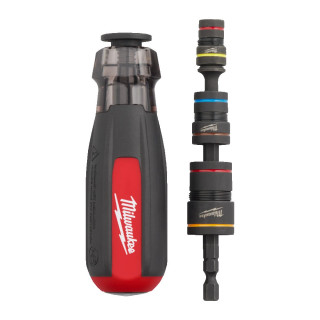
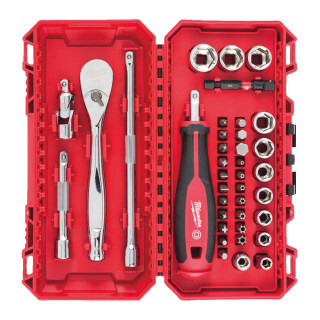
Milwaukee SHOCKWAVE Screwdrivers
For stubborn fixings, choose a Milwaukee Shockwave screwdriver that matches the screw head and the job.
Milwaukee Shockwave screwdrivers cover fastening tasks where tip fit and controlled torque matter. Check the individual specification for striking caps, magnetic tips and bolster details rather than assuming every driver has them. Choose the profile and length you need below.
What Jobs Are Milwaukee Shockwave Screwdrivers Best At?
- Tighten hinge screws and door furniture during second fix, using the correct tip size to avoid marking visible screw heads.
- Remove stubborn bracket fixings during strip-out, using a demolition model with a striking cap only where its specification permits hammer blows.
- Reach recessed screws inside cabinets and equipment housings with a shaft long enough to keep the handle clear of obstructions.
- Start screws in awkward maintenance positions with a magnetic-tip model, keeping the fixing on the tip while you line it up.
Choosing the Right Milwaukee Shockwave Screwdriver
Buy for the screw head first, then check reach and construction. A tough handle will not make up for the wrong tip.
1. Match the Profile and Size
Check whether the fixing takes Phillips, Pozidriv, slotted or another profile, then match its size. Phillips and Pozidriv are not interchangeable; a poor fit increases slipping and damages the recess.
2. Check Before Striking or Adding Leverage
If hammer blows are part of the job, choose a Milwaukee Shockwave demolition screwdriver explicitly designed for striking. If you need spanner assistance, check for a hex bolster and follow the tool's instructions. Do not strike an ordinary handle or grip a round shaft with pliers.
3. Choose Useful Reach
For recessed fixings, check both shaft length and access width. A longer driver is no help if the handle cannot turn, while an unnecessarily long shaft gets in the way inside cupboards and equipment housings.
4. Replace One Driver or Cover Several Fixings
Replace a worn everyday size individually where available. If maintenance work regularly throws up different screw heads, compare the contents of Milwaukee SHOCKWAVE Screwdriver Sets against the fixings you actually encounter.
Who Uses Milwaukee Shockwave Screwdrivers?
Maintenance fitters use these drivers for brackets, covers and service access, while joiners need accurately fitting tips for hinges and ironmongery. Refurbishment teams should look specifically for demolition-rated models when a job calls for striking a stubborn fixing. For other fastening jobs, check the wider Milwaukee SHOCKWAVE Fastening Tools range.
The Basics: Understanding Shockwave Screwdrivers
Do not choose on the Shockwave name alone. Hand screwdrivers, striking tools and power-tool bits do different jobs.
1. Hand Driving and Striking Are Different
A hand screwdriver applies turning force through its handle. A striking-rated demolition model can also accept hammer blows as specified by Milwaukee. That does not automatically make it a manual impact driver that converts each blow into rotation.
2. An Impact Driver Needs Separate Bits
If you mean accessories for a cordless Milwaukee impact screwdriver or impact driver, look at Milwaukee SHOCKWAVE Screwdriver Bits. A fixed-shaft hand screwdriver is not an accessory to fit in the machine's chuck.
Keep Your Screwdrivers and Fixings Organised
Keep the right driver within reach and stop removed fixings disappearing during maintenance.
1. Tool Roll or Screwdriver Pouch
Separate pockets make missing sizes easier to spot before leaving site and stop exposed tips rubbing against other tools. Check pocket depth against your longest driver.
2. Magnetic Parts Tray
Keep compatible steel screws together when removing access panels or door furniture. It saves hunting through dust and packaging for the last fixing during reassembly.
Choose the Right Milwaukee Shockwave Screwdriver for the Job
Match the driver to the fixing, access and force required.
| Your Job | Screwdriver Type | Key Features |
|---|---|---|
| Fitting hinges and ironmongery | Correctly sized hand screwdriver | Exact profile match and a handle you can control comfortably |
| Reaching screws behind covers | Longer-shaft screwdriver | Sufficient shaft length and clearance for the handle |
| Working on stubborn fixings during strip-out | Specified demolition screwdriver | Manufacturer-approved striking construction; bolster if spanner assistance is required |
| Servicing mixed equipment and fittings | Mixed-profile screwdriver set | Useful tip sizes rather than repeated or rarely used profiles |
Common Buying and Usage Mistakes
- Using Phillips on Pozidriv fixings damages the recess and encourages slipping. Identify the head and use the matching profile and size.
- Assuming every Shockwave screwdriver accepts hammer blows risks damaging the handle. Check that the exact model is designed for striking.
- Treating a coated or comfortable handle as electrical insulation risks electric shock. Use appropriately rated insulated tools for the task and follow safe isolation procedures.
- Using the tip as a pry bar or general-purpose chisel can bend the shaft or chip the tip. Use a tool expressly designed for that work.
Hand Screwdrivers vs Demolition Screwdrivers vs Nut Drivers
Hand Screwdrivers
Choose these for controlled fastening, final tightening and access where a power tool will not fit. Do not assume they can take striking loads simply because they look substantial.
Demolition Screwdrivers
Choose a specified striking model when refurbishment work involves stubborn fixings. Its heavier construction serves a different purpose from a slim precision driver; only use it within its stated applications.
Nut Drivers
For external hex-head fixings, compare Milwaukee SHOCKWAVE Nut Drivers. They engage around the hex head rather than inside a screw recess; check the size, drive connection and power-tool suitability.
Maintenance and Care
Clean the Tip and Handle
Remove grit and fixing debris after use. Wipe oil from the grip so you can maintain pressure without your hand slipping.
Check for Wear
Replace drivers with rounded, chipped or twisted tips. Grinding a worn cross-head tip changes its profile and will not restore the original fit.
Inspect Striking Models
Before striking, check for a loose cap, cracked handle or damaged shaft. Take a damaged tool out of service rather than trying another blow.
Store Dry
Dry wet shafts before putting them away and keep them out of damp tool bags. Follow Milwaukee's care instructions for corrosion protection and handle cleaning.
Your Milwaukee Shockwave Screwdriver Range, Ready to Go
ITS stocks the full Milwaukee Shockwave screwdriver range offered here, covering replacement drivers and sets for different fastening jobs. Stock is held in our own warehouse, ready for next-day delivery on eligible orders. Check the individual listing for current availability and delivery options before ordering.
Milwaukee Shockwave Screwdriver FAQs
What is a Milwaukee Shockwave screwdriver?
It is a screwdriver sold within Milwaukee's Shockwave fastening range. Check the exact listing to distinguish a hand screwdriver, demolition model or interchangeable-bit tool. Shockwave branding alone does not mean every tool has the same construction or accepts hammer blows.
Can you hit a Shockwave screwdriver with a hammer?
Only if that specific model is designed for striking. Look for an expressly specified striking cap and follow Milwaukee's instructions. Do not hit an ordinary screwdriver handle; wear suitable eye protection when carrying out permitted striking work.
Are Shockwave screwdrivers magnetic?
Check the individual specification for a magnetic tip or magnetic bit holder rather than assuming it across the range. Magnetism helps retain compatible steel fixings, but it will not hold every stainless steel or non-ferrous screw.
Do Shockwave screwdrivers have a hex bolster?
A hex bolster is model-dependent, so check the specification and product images before buying for spanner-assisted turning. Where provided and approved for use, it gives the spanner a proper contact point. Do not substitute pliers on a round shaft.
Are Shockwave screwdrivers sold individually?
Individual drivers and sets may be listed, depending on the model and current availability. Check the pack quantity: a single replacement is useful when one frequently used size wears out, while a set should be judged on its actual contents.
What tips do Shockwave screwdrivers come in?
Profiles and sizes vary by model and set, so use the listed tip designation and contents as your guide. Match markings such as PH, PZ or TX to the fixing, and check the size as well. Similar-looking tips are not necessarily interchangeable.
Are Shockwave screwdrivers insulated?
Do not treat Shockwave branding as an insulation rating. For electrical tasks requiring insulated tools, choose correctly rated tools such as those in the Milwaukee VDE Screwdriver Sets & Screwdrivers range. Insulated tools do not replace safe isolation or proving dead.
Do Shockwave screwdrivers have a lifetime warranty?
Milwaukee offers a limited lifetime guarantee on eligible hand tools, but check the terms applying to the exact screwdriver before buying. It is not a promise to replace normal wear, misuse or accidental damage. Keep your proof of purchase for any claim.