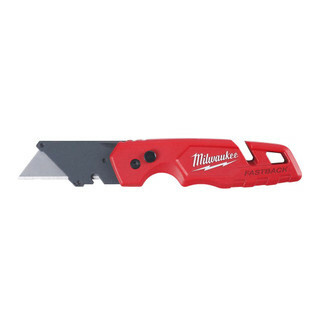
Milwaukee Fastback Cutting Tools
Opening packs or trimming floor coverings, a Milwaukee Fastback knife keeps a cutting edge close to hand.
The folding design covers the edge between cuts, while utility versions take replaceable blades for work that quickly dulls them. Check the blade type, storage and opening mechanism before choosing your Milwaukee Fastback for the tool bag.
What Jobs Are Milwaukee Fastback Knives Best At?
- Open cardboard cartons and cut packaging straps when unloading fittings, keeping the blade clear of cables, finished surfaces and your supporting hand.
- Score plasterboard faces before snapping sheets during drylining, using a straightedge and a sharp utility blade for a controlled cut.
- Trim roofing felt and floor coverings with a utility model and a blade approved for the material, working over a suitable cutting surface.
- Break down empty packaging during shopfitting and refurbishment work, replacing a dull utility blade rather than forcing it through heavy cardboard.
Choosing the Right Milwaukee Fastback Knife
Choose the blade system first. A folding utility knife and a folding knife with a resharpenable blade are not interchangeable purchases.
1. Replaceable or Resharpenable Blade
If plasterboard, felt or cardboard regularly takes the edge off your blade, choose a Milwaukee Fastback utility knife that accepts replacement blades. If you want a conventional folding blade, check its profile and sharpening requirements rather than assuming it takes utility blades.
2. Spare Blade Storage
If you are moving between rooms cutting abrasive materials, onboard blade storage saves a trip back to the tool bag. Storage is model-dependent, so check the stated capacity; a compact handle does not necessarily hold spare blades.
3. Straight Cutting or Added Functions
Choose a straightforward cutter if you already carry separate screwdrivers. Consider the Milwaukee Fastback 6 in 1 if its integrated driver and other listed functions suit small maintenance jobs, but check the supplied bit specification before relying on it for your fixings.
4. Site Rules and Safe Carrying
If the site requires concealed-blade or self-retracting safety knives, a folding Fastback may not meet that requirement. Check before buying, and do not assume a locking knife is lawful to carry in public without a good reason.
Who Uses Milwaukee Fastback Knives?
Dryliners use utility versions for scoring plasterboard, while floorlayers and roofers choose suitable replaceable blades for trimming sheet materials. Fitters and maintenance teams keep a folding knife with their tools for opening deliveries and cutting packaging; check site knife rules before bringing one onto the job.
Accessories for Blade Changes and Safe Disposal
For replaceable-blade Fastback models, carry the correct spares and somewhere secure to put used blades.
1. Compatible Replacement Utility Blades
A dull edge makes you push harder and reduces control. Keep compatible replacement blades in their dispenser, and check the knife instructions before fitting specialist profiles such as hooked blades.
2. Purpose-Made Blade Disposal Container
Loose used blades can cut through rubbish sacks and injure whoever clears the site. Put them straight into a suitable blade disposal container and follow the site's waste procedure.
Choose the Right Milwaukee Fastback Knife for the Job
Match the blade system and handle features to the work you actually do.
| Your Job | Knife Type | Key Features |
|---|---|---|
| Scoring plasterboard during drylining | Fastback folding utility knife | Replaceable utility blade and secure blade retention. |
| Repeated packaging cuts across a large fit-out | Utility model with spare blade storage | Onboard replacements and tool-free blade changes where specified. |
| Small maintenance jobs involving cuts and screw fixings | Fastback 6 in 1 | Utility blade and integrated driver; check the included bit. |
| General cutting where you maintain your own edge | Fastback with a resharpenable folding blade | Suitable blade profile and an edge you sharpen rather than replace. |
Common Buying and Usage Mistakes
- Buying by the Fastback name alone can leave you with the wrong blade system. Check whether the exact model takes disposable utility blades or has a resharpenable folding blade.
- Assuming every handle stores spare blades leads to wasted trips back to the van. Check the listed storage capacity rather than judging by the handle size.
- Forcing a blunt blade through board or packaging increases the chance of slipping. Replace or sharpen the blade as appropriate, and support the material properly.
- Using the tip as a screwdriver or pry bar can break the blade and damage the holder. Use a separate tool, or the dedicated driver on a suitably equipped model.
- Treating a folding knife as automatically acceptable on site or in public can cause problems. Check the site's cutting-tool policy and the legal requirements for carrying your particular knife.
Fastback Utility Knife vs Resharpenable Folding Knife vs Safety Knife
Fastback Utility Knife
Choose this for abrasive materials that quickly blunt an edge, such as plasterboard and cardboard. Replacement blades restore the edge quickly, but the exposed blade still needs careful handling and may not meet a site's safety-knife policy.
Resharpenable Folding Knife
Choose this when the blade profile suits your cutting work and you are prepared to maintain its edge. It avoids disposable blade changes, but sharpening takes longer than swapping a utility blade and it is not the first choice for repeated plasterboard scoring.
Concealed-Blade or Self-Retracting Safety Knife
Choose a suitable safety knife where the task or site policy calls for reduced blade exposure. Concealed designs suit compatible packaging cuts but restrict cutting depth; self-retracting models offer different access, so match the design to the material.
Maintenance and Care
Clear Dust and Adhesive
Remove plaster dust and packaging residue before they build up around the pivot or blade holder. Follow the model's cleaning instructions and keep fingers clear of the cutting edge.
Check Retention and Locking
Before use, check that the blade is properly seated and the locking mechanism engages fully. Stop using the knife if the blade moves unexpectedly or the lock fails to hold; do not improvise a repair.
Maintain the Cutting Edge
Replace damaged or blunt utility blades promptly. Sharpen resharpenable blades using a suitable method and the recommended angle; disposable utility blades should be replaced rather than ground back.
Store Clean, Dry and Closed
Dry the knife after damp work and close it before storage. Keep it secure with your tools rather than loose in a pocket with screws and grit, and follow the manufacturer's guidance on pivot lubrication.
Why Shop for Milwaukee Fastback Knives at ITS?
ITS stocks the full Milwaukee Fastback cutting-tool range, covering compact utility knives, spare-blade storage options and multifunction models. Stock is held in our own warehouse, ready for next-day delivery. Check the individual listing for the blade type, included contents and current availability before ordering.
Milwaukee Fastback Knife FAQs
What is a Milwaukee Fastback knife?
Milwaukee Fastback is a range of folding cutting tools. It includes utility knives with replaceable blades and folding knives with resharpenable blades. Features such as spare blade storage, integrated drivers and opening mechanisms vary, so choose by the exact model specification rather than the Fastback name alone.
Is the Milwaukee Fastback legal to carry in the UK?
Do not treat it as an unrestricted everyday-carry knife. Locking knives do not qualify for the exemption covering non-locking folding pocketknives with a cutting edge of 3 inches or less. Carrying one in public generally requires a good reason or lawful authority; genuine work use may provide a good reason, but the circumstances matter. A short blade or a work-related purchase is not blanket permission to carry it everywhere.
How do you change the blade on a Milwaukee Fastback?
On replaceable-blade utility models, follow the instructions for opening the holder and operating the blade-release mechanism. Keep your hands away from the edge, remove the old blade and fully seat the compatible replacement. Check that it is securely retained before cutting. Models with a resharpenable folding blade do not use this utility-blade change system.
What blades fit the Milwaukee Fastback?
Fastback utility models generally use standard trapezoidal utility blades, but check the exact model's compatibility requirements. Do not assume snap-off segments, unusually thick blades or specialist hooked profiles will fit. Fastback knives with resharpenable folding blades do not accept standard replacement utility blades.
Is the Milwaukee Fastback a locking knife?
Fastback folding models commonly lock open for cutting. Check the exact model's mechanism, and make sure it engages fully before use. A locking mechanism helps prevent accidental folding, but it does not make the knife suitable for prying or remove the legal restrictions on carrying locking knives in public.
Does the Milwaukee Fastback have a belt clip?
Many Fastback models have a wire-form pocket clip, but check the individual listing. A pocket clip is not necessarily sized for a thick work belt, and it is not a rated tether point for working at height. Carry the knife fully closed and follow site rules.
Is the Milwaukee Fastback one-handed opening?
Many Fastback models feature press-and-flip one-handed opening. You operate the release and move the blade holder into position; it is not simply a powered opening action. Check the exact mechanism, keep the opening path clear and confirm the blade is locked before starting a cut.
How many blades come with a Milwaukee Fastback?
The supplied quantity depends on the model and pack. Check the listing's included contents: a handle advertised as storing several spare blades is not necessarily supplied with that many. Resharpenable folding-blade models do not include a supply of disposable utility blades unless a separate bundle explicitly states otherwise.