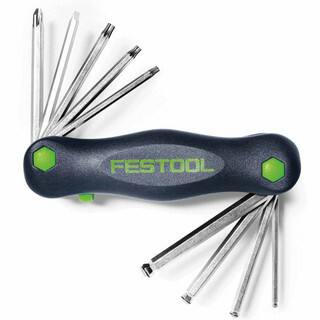
Festool Allen Keys (Hex Keys)
Festool Allen keys are for the fixings you cannot round off, strip, or bodge when you are mid-build and need a clean, positive fit.
When you are tightening hinges, adjusting guides, or stripping a machine down for a blade change, a decent hex key matters. Festool Allen keys and Festool hex keys are made to sit properly in the socket, so you get torque without chewing the head. Choose a Festool hex wrench set or Festool folding Allen keys to keep the right size to hand and stop wasting time hunting round the van.
What Jobs Are Festool Allen Keys Best At?
- Adjusting fences, stops, and guide components on site kit when you need settings to stay put and not slip after the first cut.
- Changing blades, cutters, and accessories where a snug-fitting Festool hex key stops you rounding the socket and turning a quick swap into a fight.
- Tightening machine screws on hinges, ironmongery, and hardware installs when you are working in tight corners and need controlled torque.
- Keeping a Festool folding Allen keys set in your pocket for call-outs and snagging, so you can hit common sizes without dragging a full tool bag around.
- Using a Festool multi-tool hex where the job needs compact access, like inside cabinets, plant panels, or awkward service voids.
Choosing the Right Festool Allen Keys
Pick the set that matches how you actually work day to day, not what looks neat in the drawer.
1. Folding set vs separate L-keys
If you are doing adjustments and snagging on the move, Festool folding Allen keys are the grab-and-go option that stays together. If you are on bench work or you need maximum leverage, separate L-keys give you better reach and torque without skinning your knuckles.
2. Ball end vs straight end
If you are working at an angle inside cabinets or around guards, a ball end helps you get purchase where a straight key will not line up. For final tightening and cracking stubborn fixings loose, use the straight end so you do not risk cam-out.
3. Size range and duplicates
If you are always losing the same few sizes, buy a set that covers your regular fixings and consider a spare of the most-used keys. There is no point carrying odd sizes you never touch if the common ones are missing when the machine is in bits.
Who Uses Festool Hex Keys on Site?
- Chippies and joiners doing fit-out work, because a proper-fitting hex key set makes fine adjustments on guides, hinges, and jigs without slipping.
- Kitchen fitters and maintenance teams, who need compact access for cabinet hardware and quick tweaks during snagging and call-backs.
- Site carpenters and workshop lads stripping down and servicing kit, where the right Festool hex wrench set saves fasteners and keeps downtime down.
How Hex Keys Work for You
Hex keys are simple, but the details decide whether you get clean torque or a rounded fixing. Here is what matters on site.
1. Fit in the socket
A hex key needs to seat fully and snugly in the screw head. If it is sloppy, it will twist and chew the corners, and then you are drilling it out instead of finishing the job.
2. Ball ends are for access, not brute force
Ball ends let you drive a screw when you cannot get straight onto it, which is common in tight installs. They are not the best choice for high torque, so do the final nip-up with the straight end when you can.
3. Long arm vs short arm
Long arms give reach and leverage for deeper fixings and awkward access. Short arms are for tight spaces and controlled turning when you do not want to over-tighten small machine screws.
Shop Festool Allen Keys at ITS
Whether you need a single replacement key, a Festool hex wrench set for the workshop, or Festool folding Allen keys for the pocket, we stock the range to cover everyday site sizes and awkward access jobs. It is all held in our own warehouse, in stock and ready for next day delivery.
Festool Allen Keys and Hex Keys FAQs
Do Festool Allen keys come with ball ends?
Some Festool Allen keys do come with ball ends, but not every key in every set will be ball-ended. Check the product details for the exact set, because ball ends are there for angled access, not for maximum torque on stubborn fixings.
What sizes are included in a Festool hex key set?
It depends on the specific Festool hex wrench set, as different kits are built around different use cases. Before you buy, match the set sizes to the fixings you actually see on your kit and hardware, so you are not missing the one size you use every day.
Are Festool folding Allen keys any good for site work, or are they just for light jobs?
They are solid for adjustments, snagging, and day-to-day tweaks because they are quick to grab and hard to lose. For cracking tight fixings loose or doing final tightening, a separate L-key usually gives you better leverage and control.
Will these stop me rounding off hex screws?
They help, but the main thing is using the right size and seating it fully before you pull. If the key is not fully home, or you use a ball end for heavy tightening, you can still round the head and turn a five-minute job into a drill-out.
Do I need metric or imperial Festool hex keys?
On most UK and EU site kit you will be living in metric, and that is what you should buy unless you know you have imperial fixings in the mix. If a key feels close but not quite, stop and swap, because that is how sockets get chewed.